|
|
 Posted - November 16 2009 : 9:28:33 PM Posted - November 16 2009 : 9:28:33 PM


|
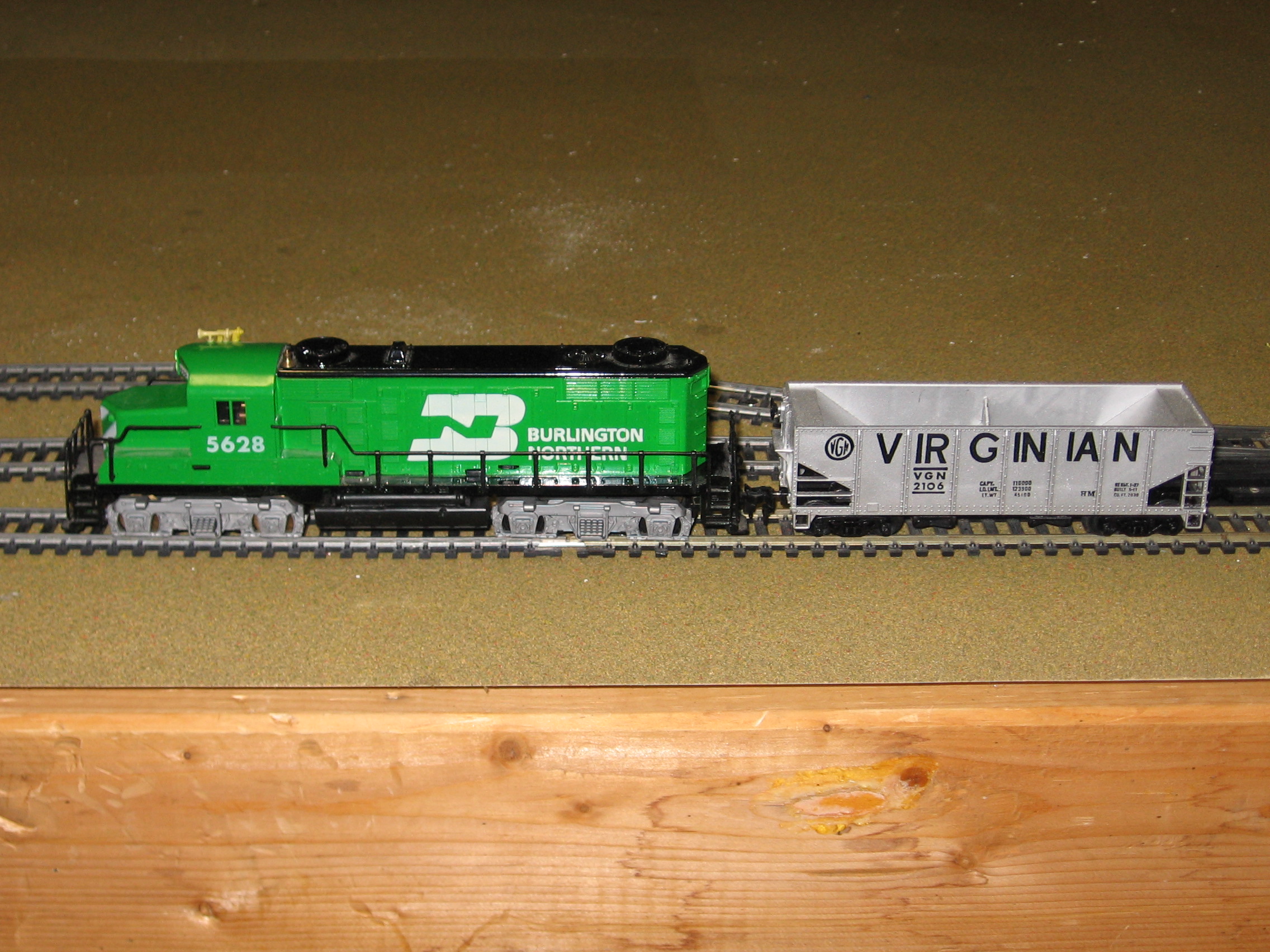
I have been working on my layout for about 2 hours now, and haven't made much progress on this problem I'm having. I attached Atlas brand rail joiners with pre-soldered leads, and hooked it up to my Tyco transformer. I put my Tyco Burlington Northern GP-20 on the track, intending to test a rather sharp curve I had recently installed. However, the loco hardly ran at all, stopping and starting randomly, and I had to tap/push/help it along to get it to go anywhere I attached Atlas brand rail joiners with pre-soldered leads, and hooked it up to my Tyco transformer. I put my Tyco Burlington Northern GP-20 on the track, intending to test a rather sharp curve I had recently installed. However, the loco hardly ran at all, stopping and starting randomly, and I had to tap/push/help it along to get it to go anywhere
I took the loco apart, cleaned and lubed the motor, and tested it by putting the wires from my transformer in direct contact with the pickup wheels. It worked beautifuly. I popped it back on the track, but the same thing happened as when I started .
I used my multimeter to test the whole track, and my results proved all the track on the layout was conducting electricity superbly. I played around with the locomotive some more, and found something interesting: whenever I ran it on a brand new section of flextrack I had installed, it worked fine. But when I ran it on the rest of the track (miscelaneous pieces from ebay, trains shows, etc.) It behaved the same as in the beginning.
I tried an AHM locomotive, and got the same results. So, my question is, (more like questions) I think it's pretty obvious that the track is causing the problem, but will I have to replace all of the bad track? Or can I clean it, or do something to fix the problem? I've heard of rubbing vaseline on the track as a solution, what are your thoughts on that? Any information is appreciated. Thanks a lot for the help.
-Jacob
Quote: "I didn't fail, I just found 1200 materials that won't work"
-Thomas Edison
|
Country:  USA ~
Posts: 232 ~
Member Since: March 29 2009 ~
Last Visit: March 22 2010 USA ~
Posts: 232 ~
Member Since: March 29 2009 ~
Last Visit: March 22 2010
|
 Alert Moderator
|
|
|
|
 Posted - November 16 2009 : 10:05:05 PM Posted - November 16 2009 : 10:05:05 PM
|
to me it sounds like you have dirty track. you could use a piece of scotch bright or somethink like that on the older track & see if that helps.
jerry
|
|
Country: USA ~
Posts: 553 ~
Member Since: January 14 2009 ~
Last Visit: September 13 2024
|
Alert Moderator

|
|
|
|
Posted - November 16 2009 : 10:51:52 PM
|
| following on Smokies suggestion - emery cloth sandpaper of 700 or higher grit to polish rails - low grit sandpaper 60 70 or lower numbers are too abrasive--if you don't neither scotchbrite or sandpaper - rubbing alcohol will clean track too.
|
|
Country: USA ~
Posts: 2507 ~
Member Since: January 31 2006 ~
Last Visit: October 21 2017
|
Alert Moderator
|
|
|
|
Posted - November 16 2009 : 10:56:05 PM
|
| I'm with Jerry...clean your track with a "Bright Boy" track cleaner.
|
|
|
|
|
Posted - November 16 2009 : 11:12:36 PM
|
I agree with everything that has been said. You have dirty track. I just built my new layout this summer, using a lot of brand new track, and I still have to do routine cleaning. It's just part of the game.
One thing to consider is the type of track you have....in my experience, steel track is the hardest to keep clean. Brass is somewhat easier--it tarnishes, but cleans easily. Nickel silver is the easiest to maintain.
No matter what type you have, clean it with a track cleaner eraser or scotch brite. You can also use rubbing alcohol on a cloth. Just rub it over the rails and you'll be surprised at what you pick up. For extreme cases, use sandpaper....it's not a good idea, but it works if the track is extremely rusty.
I almost forgot....another thing I've had trouble with is loose rail joiners. Sometimes when you reuse or rearrange track, the joiners loosen up. Replacing them is cheap, easy, and always a good idea. I've just got to the point where I always replace them when I get used track, even if they seem good.
Edited by - burlington77 on November 16 2009 11:15:29 PM
|
|
Country: USA ~
Posts: 1166 ~
Member Since: October 18 2009 ~
Last Visit: December 23 2018
|
Alert Moderator
|
|
|
|
Posted - November 17 2009 : 08:20:52 AM
|
Thanks a lot for the help guys, I figured It had something to do with dirty track. Burlington77, I tested all of the track with a multimeter, and it all was fine in conducting electricity, so I assume my rail joiners are fine. Some of them I may have to replace though. Thanks a lot.
-Jacob
Quote: "I didn't fail, I just found 1200 materials that won't work"
-Thomas Edison
|
|
Country: USA ~
Posts: 232 ~
Member Since: March 29 2009 ~
Last Visit: March 22 2010
|
Alert Moderator
|
|
|
|
Posted - November 17 2009 : 09:46:56 AM
|
| Any of the track made of brass? It is a constant maintenance job keeping this kind of track up to par.
|
|
Country: USA ~
Posts: 825 ~
Member Since: December 22 2008 ~
Last Visit: March 16 2015
|
Alert Moderator
|
|
|
|
Posted - November 17 2009 : 4:15:12 PM
|
The track is a mixture of brass, nickel, steel, you name it. Some of it I'm not even sure which type it is. I may end up replacing all of the cheap track when I get the money.
-Jacob
Quote: "I didn't fail, I just found 1200 materials that won't work"
-Thomas Edison
|
|
Country: USA ~
Posts: 232 ~
Member Since: March 29 2009 ~
Last Visit: March 22 2010
|
Alert Moderator
|
|
|
|
Posted - November 17 2009 : 4:21:48 PM
|
| This seems to be one of those topics that causes an eternal debate. Personally, I don't mind brass at all. I hate steel. Nickel silver is my favorite. I find that brass, while it needs cleaning, is easier to clean.
|
|
Country: USA ~
Posts: 1166 ~
Member Since: October 18 2009 ~
Last Visit: December 23 2018
|
Alert Moderator
|
|
|
|
Posted - November 17 2009 : 5:07:03 PM
|
Your right, it seems like a conclusion can never be reached on the subject of different types of tracks. I personally prefer nickel silver or steel, but I got a really good deal on a mixed lot of track, and brand new nickel silver or steel can really strip your wallet so I went with the mixed lot. so I went with the mixed lot.
-Jacob
Quote: "I didn't fail, I just found 1200 materials that won't work"
-Thomas Edison
|
|
Country: USA ~
Posts: 232 ~
Member Since: March 29 2009 ~
Last Visit: March 22 2010
|
Alert Moderator
|
|
|
|
Posted - November 17 2009 : 6:41:41 PM
|
Well, I just cleaned my track with some makeup pads and 90% Isopropyl alcohol, and came up with some really strange results. I stuck on my AHM loco that ran pretty well on the new section of steel track before I cleaned the track, and hooked up the transformer. The locomotive barely ran, and stuttered, even on the steel section
However, the light in the windshield wasn't even coming on, so I got suspicious. I used my multimeter, and found out that only about 4 volts were getting to the track when the power pack was at maximum power (normally I think about 12-15 volts are supposed to be going to the track)
I forgot to mention this in my original post, but I had to stop playing around with my locomotive because my power pack started acting up and was only putting out about 4 volts. It was getting pretty warm, so I thought it might be overheated or something, as I had been using it for over 2 hours straight, and decided to call it quits. When I went to test my locomotive on my newly cleaned track (after the transformer had rested overnight) the same thing happened.
So I switched to a different TYCO powerpack, and got the same results. I played around with my multimeter some more, and found out that the power pack was actually outputting the normal 12 volts, but somehow only 4 volts were reaching the track, and therefore the locomotive. This is really weird, because I have wires directly attached to the screws on the transformer, and have those connected to the leads of some Atlas wired rail joiners, and I have the rail joiners joining two pieces of track.
I am going to go play around with my multimeter some more, and see what I can come up with. But for now I am dumbfounded, and have only one faint idea of what could possibly be happening, but its a little far-fetched. Maybe when I connect the power to the track, It has more metal to travel through, and it is lowering the current available per piece of track. Okay, maybe its a LOT far-fetched. But I can't come up with anything else. If you have any ideas, or input, shoot away, cuz I'm sure stumped for now.
-Jacob
Quote: "I didn't fail, I just found 1200 materials that won't work"
-Thomas Edison
|
|
Country: USA ~
Posts: 232 ~
Member Since: March 29 2009 ~
Last Visit: March 22 2010
|
Alert Moderator
|
|
|
|
Posted - November 17 2009 : 7:06:18 PM
|
DISREGARD THE ABOVE POST Now I'm going to look like a complete idiot . . . I played around a little more, and now I have the power going perfectly. I have no idea what happened earlier, but now everything is running smoothly. Just have to finish cleaning the track, and hopefully everything will be a-okay. Hopefully. Now I'm going to look like a complete idiot . . . I played around a little more, and now I have the power going perfectly. I have no idea what happened earlier, but now everything is running smoothly. Just have to finish cleaning the track, and hopefully everything will be a-okay. Hopefully.
-Jacob
Quote: "I didn't fail, I just found 1200 materials that won't work"
-Thomas Edison
|
|
Country: USA ~
Posts: 232 ~
Member Since: March 29 2009 ~
Last Visit: March 22 2010
|
Alert Moderator
|
|
|
|
Posted - November 17 2009 : 7:07:23 PM
|
I am not an expert on this. Here are some suggestions.
You can test for a voltage drop. Put one test lead on the + post of your powerpack. While keeping it there, systematically probe different points of the + or hot side circuit of your tracks with the other test lead. If you don't have any problems your multimeter should read 0 volts or maybe .1 or .2 volts. Start at the screw attachment of your atlas track and continue probing down the same rail.
You could test the power pack output with it disconnected to the track.
Then connect the powerpack back to the track and check the output again right at the powerpack output. A short circuit could be drawing down the voltage of the powerpack. Make sure there is nothing on the track, no rolling stock.
|
|
Country: USA ~
Posts: 825 ~
Member Since: December 22 2008 ~
Last Visit: March 16 2015
|
Alert Moderator
|
|
|
|
Posted - November 17 2009 : 7:15:29 PM
|
I see I made my post 1 minute and 5 seconds after you posted a success.
I don't know if it will help anybody but, I was also thinking that if a loco was
acting up, you could turn off all the lights. Then try to run the loco. Bad connections and poor wheel contact should show up as little blue sparks.
|
|
Country: USA ~
Posts: 825 ~
Member Since: December 22 2008 ~
Last Visit: March 16 2015
|
Alert Moderator
|
|
|
|
Posted - November 17 2009 : 7:21:40 PM
|
This is a bit late, but in case it acts up again:
It's very common for the feeder wire to break inside the insulation where it is crimped into the rail joiner, which could cause complete or intermittent interruption of the power.
If that's not it, does the transformer voltage drop when you attach the feeder wires to the transformer terminal? That would indicate a short somewhere across the track or wiring.
Have you measured the voltage at the powered rail joiners themselves? If they were getting full power, that would indicate a loose connection or oxidation between them and the rails.
The Tyco Depot
|
|
Country: USA ~
Posts: 3927 ~
Member Since: June 20 2007 ~
Last Visit: November 19 2015
|
Alert Moderator
|
|
|
|
Posted - November 17 2009 : 7:26:49 PM
|
Hey NC short, I was going to mention it, but decided it was nothing. My locomotive is sparking a whole lot when it runs. I guess that means it pretty much has to be bad connection between the loco and the rails/dirty tracks.
Nickelplate, just noticed your post as I was typing this, you posted it about 3 seconds ago Everything is working fine now, I think I pobably had a screwdriver or something laying across the tracks, which caused a short.
Thanks for he help everyone!
-Jacob
Quote: "I didn't fail, I just found 1200 materials that won't work"
-Thomas Edison
|
|
Country: USA ~
Posts: 232 ~
Member Since: March 29 2009 ~
Last Visit: March 22 2010
|
Alert Moderator
|
|
|
|
Posted - November 17 2009 : 7:32:55 PM

|
Sparking wheels eh? I find that when dirty track is not the case, dirty locomotive wheels are often the problem! They can be cleaned using the methods listed above for track. 
    
- Matt -
|
Country:  Canada ~
Posts: 1021 ~
Member Since: August 24 2008 ~
Last Visit: January 05 2020 Canada ~
Posts: 1021 ~
Member Since: August 24 2008 ~
Last Visit: January 05 2020
|
Alert Moderator
|
|
 Home
Home Forums
 Events Calendar
 Forum Admins & Mods
 Register