|
|
 Posted - October 28 2014 : 6:49:36 PM Posted - October 28 2014 : 6:49:36 PM


|
I got an early TYCO Sharknose on Ebay recently, nice condition but needed repairing. I took apart the motor, cleaned/oiled everything, and put it back together. The motor runs fine when I place the powered wires directly on the wheels, but when I set the locomotive on cleaned, powered track, It doesn't run at all. I think it may be due to the wheels on the front truck not contacting the brass pickup plate, but I don't know how to fix this problem. Any ideas?
Thanks,
ChessieRR
|
Country:  USA ~
Posts: 332 ~
Member Since: February 24 2012 ~
Last Visit: January 26 2015 USA ~
Posts: 332 ~
Member Since: February 24 2012 ~
Last Visit: January 26 2015
|
 Alert Moderator
|
|
|
|
Posted - October 28 2014 : 9:38:38 PM


|
Hmm, pick-up plate? Mine doesn't have that on the wheels. My Mantua metal shark uses the axle points to pick up power and transmit it back to the motor via wires. Looking at mine, I noticed two things ( I don't know if mine runs or not ) - the brass wheels on both rear and front trucks are on the SAME SIDE. So it won't pickup power from the other rail. I need to reverse that. The other thing I notice is that the wires going to the front truck potmetal frame on top are screwed down, and there is white corrosion around the brass ring terminals. They need to be taken off and cleaned up. Another spot is the side truck frames, which are pot metal, and the metal axles won't make good contact with them if they are corroded, too. I notice that my side frames are riveted on, so taking them off to clean them is problematic. Not sure how to clean up the axle points , as shining a light inside, I see some rust on the tapered axle ends where I can see them. Maybe some dental floss? Here's some pictures of mine, I had it handy near the computer 
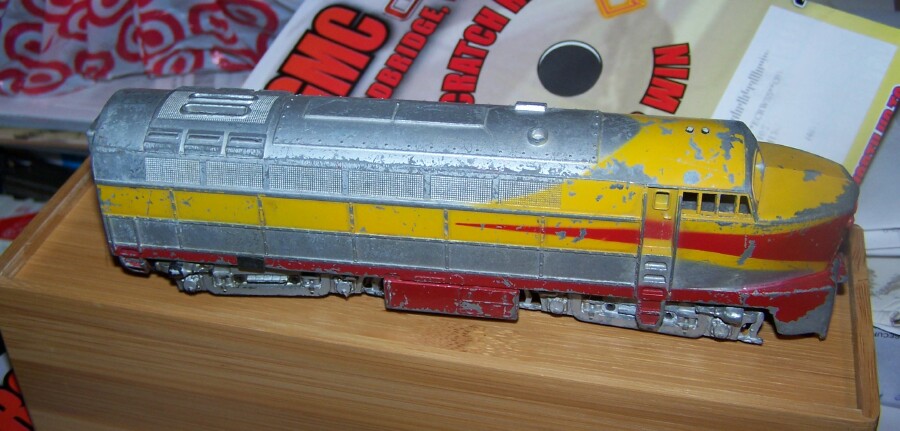 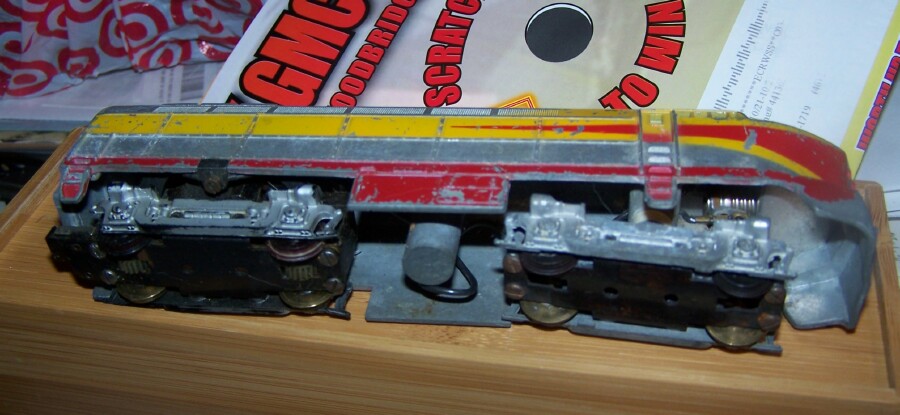 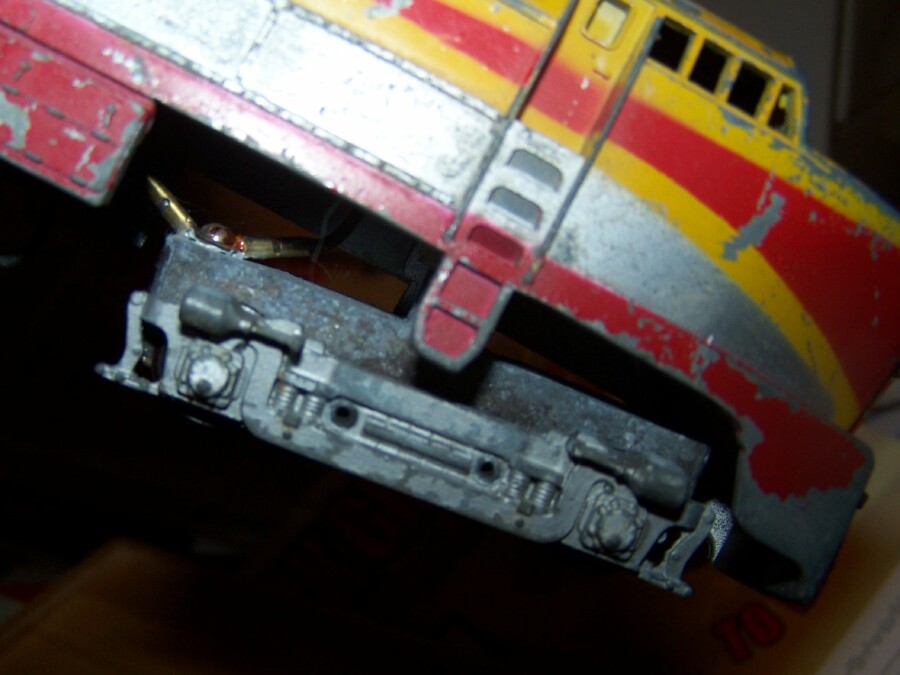
These old sharks get stubborn with age, I have anothe rmetal one, and it runs REAL slow. I would have to believe that with the antiquated electrical pick-up design, it must be in tip-top shape to power this heay beast, and neither of my two are that. You'll need to clean ALL electrical contact areas thoroughly to allow it to operate at optimum pick-up with minimal resistance. Hope my pictures help, and you can get yours running well. I will do some work on mine, and see how it runs after my efforts. 
Jerry
" When life throws you bananas...it's easy to slip up"
|
|
Country: USA ~
Posts: 3974 ~
Member Since: January 04 2009 ~
Last Visit: January 11 2019
|
Alert Moderator

|
|
|
|
Posted - October 29 2014 : 3:08:50 PM
|
The "pickup plate" I am talking about is the brass plate under the truck assembly. The brass wheels on my sharknose are on opposite sides on either truck. The wheels tend to slide around in the truck and I don't think they touch the metal plates when the locomotive is on the track.
Thank you for the pictures, it's helpful to see how the truck assembly should look.
Thanks,
ChessieRR
|
|
Country: USA ~
Posts: 332 ~
Member Since: February 24 2012 ~
Last Visit: January 26 2015
|
Alert Moderator
|
|
|
|
Posted - October 30 2014 : 12:05:35 AM
|
quote: quote:The "pickup plate" I am talking about is the brass plate under the truck assembly.
Thank you for the pictures, it's helpful to see how the truck assembly should look.
Thanks,
ChessieRR
Originally posted by ChessieRR - October 29 2014 : 3:08:50 PM
|
Hey, does your front truck have a brass plate? I only have one in the power truck, there is none up front in the non-powered truck. The only contact is the axle points into the side truck frames.  Or, are you talking about the black bottom mounting plate I have, which is probably brass....that is not supposed to contact the axles, I don't believe. Or, are you talking about the black bottom mounting plate I have, which is probably brass....that is not supposed to contact the axles, I don't believe.
At any rate, here's how my metal shark repair went tonight - took it apart, cleaned the front truck assembly up, not happy with just the axle point contact. Moved to the rear power truck, it wouldn't even turn over, the light on my Tech II supply would dim. Ok, pulled it out and got the power truck apart, and tried moving the armature by hand. Boy was it TIGHT. One of the side motor plates was touching the rotating assembly. I loosened the screw holding the two plates to the magnet, and putting it on a flat plastic surface, I pressed until both plates were square and even with the magnet along the top. Tightened the screw, and saw that both side plates were not touching and had good gap. I hit the brush contacts with the power wires, and it started spinning.  Main power problem solved! Got some alcohol and cleaned the brush plates, brushes, and cleaned out any hair in the worm gear area. Luckily Tyco made this pre-MU2 motor with screws instead of rivets, it is easy to disassemble and clean everything. With the motor plates re-aligned, the gunk and junk out of the electrical paths, I reassembled the motor/truck assembly, and powered it again, still working, not a high-revving motor, but had plenty of RPMs at this point. Main power problem solved! Got some alcohol and cleaned the brush plates, brushes, and cleaned out any hair in the worm gear area. Luckily Tyco made this pre-MU2 motor with screws instead of rivets, it is easy to disassemble and clean everything. With the motor plates re-aligned, the gunk and junk out of the electrical paths, I reassembled the motor/truck assembly, and powered it again, still working, not a high-revving motor, but had plenty of RPMs at this point.
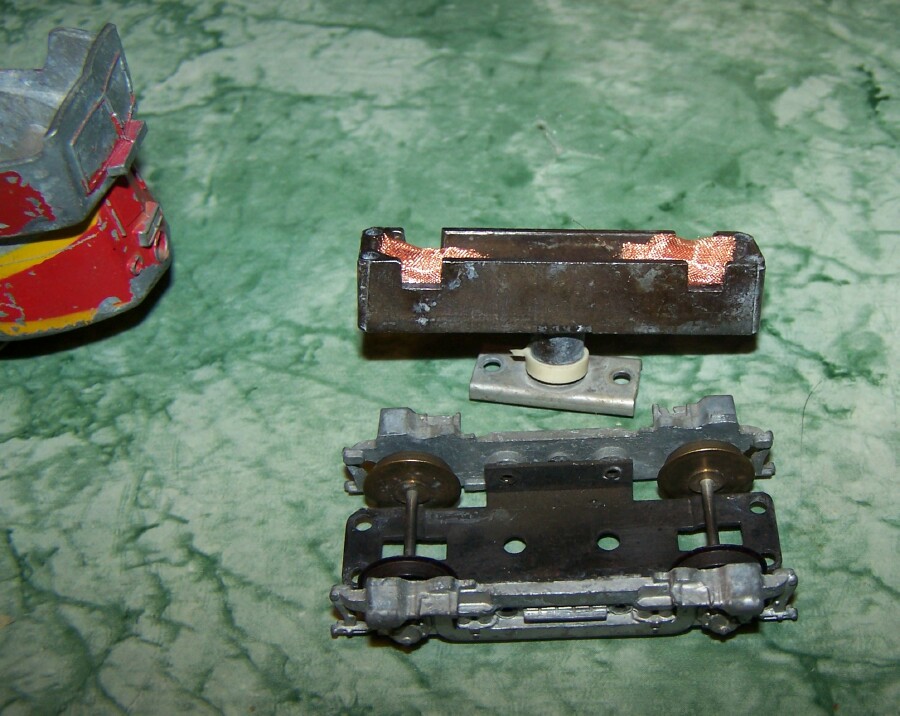
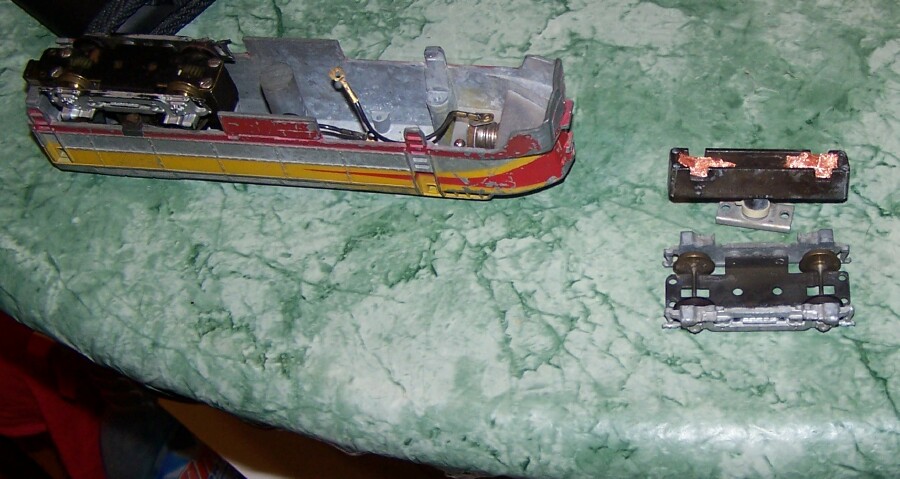
Back to the front truck. With only the axle points giving direct contact through the frame, I decided on an "upgrade". I used a brass wire brush in my dremel, and cleaned up inside the truck housing the brass wheels, and the axle shafts. And the wire screw-down area. Then I headed to the basement, and got some fine copper mesh I had from days working at a hush-hush company building shielded computers. I folded some scrap strips multiple times, and put them down in each end of the non-power truck. I placed the axle plate assembly on the main truck body, and made sure that the copper was giving some rolling resistance, but not a heavy contact. The wheels turn, not truly free, but not much resistance, either. Putting it all back together, I found some screws to replace the missing one holding it to the body. Got it all back together while watching the World Series, and at 11:30, I took it upstairs to my stairway layout for it's first run after repairs. 
Got it on the rails, and applying power, it proceeded to move slowly, until I turned the MRC up to 3/4 power, then it moved faster. Not a very fast engine, but it was fairly smooth. Still has a few fits and starts while running, I suspect the power truck brass contact plate needs cleaning. This type of plate is also used in the Trolleys, and they are not exactly the best way to conduct electricity to the motor.  On the other hand, I think the copper mesh up front really helps the contact, as there are more points of contact, and it's not a heavy contact, either. Not sure I can use that on the power truck, but will clean it out and see if it will work or not. Here's some pictures of my mesh install in the front truck assembly. On the other hand, I think the copper mesh up front really helps the contact, as there are more points of contact, and it's not a heavy contact, either. Not sure I can use that on the power truck, but will clean it out and see if it will work or not. Here's some pictures of my mesh install in the front truck assembly.
Originally posted by AMC_Gremlin_GT - October 29 2014 : 11:57:55 PM
|
" When life throws you bananas...it's easy to slip up"
|
|
Country: USA ~
Posts: 3974 ~
Member Since: January 04 2009 ~
Last Visit: January 11 2019
|
Alert Moderator
|
|
|
|
Posted - March 02 2015 : 09:39:30 AM
|
I just got one of these things myself for $15 and man does it run slow. I'm hoping all it needs is lube.
-Steve
"A lot of modellers out there who go to these train shows see broken HO stuff and go, 'This is useless' when, in reality, they can still be used for modeling whether it's as a prop on your layout or a cool project to make something old new again."
Edited by - kovacste000 on March 02 2015 09:42:21 AM
|
|
Country: USA ~
Posts: 3533 ~
Member Since: February 17 2014 ~
Last Visit: January 11 2023
|
Alert Moderator
|
|
|
|
|
|
 Home
Home Forums
 Events Calendar
 Forum Admins & Mods
 Register