|
mekyll
Switcher
Status:
offline
| |
 Posted - July 07 2015 : 4:23:10 PM Posted - July 07 2015 : 4:23:10 PM


|
I am new to this forum and looking for help now since I have some tycos and now have the time and money to fix them. They are sentimental to me because they were my grandfather's and he gave them to me when I was about 12. Now I want to restore them if possible to run, not necessarily DCC, but in working order.
I have:
F3 or F7: Union Pacific, Sante Fe (blue and yellow), C&O? (blue/black)
Alco 430 Rock island
Alco 630 Illinois Gulf
and
2-8-2 Camel back (PENN)
These have been shelved for so long and not run at all. I cannot get them to run whatsoever.
I need some sort of guidance of what I can do to get these to run or what must be replaced, as tyco parts do not exist anymore unless I buy another one to just strip it for parts.
Do these chassis work on any other bodies? (athearn or bachmann)
Looking for any sort of information, good or bad.
The main two I want to work are the 630 and 2-8-2.
The F3/f7s I would like to know if something could be put in the window area, to look like windows instead of empty space.
Also need to know where I can get the plastic piece that fits over the wheels.
|
Country:  USA ~
Posts: 9 ~
Member Since: July 07 2015 ~
Last Visit: July 11 2019 USA ~
Posts: 9 ~
Member Since: July 07 2015 ~
Last Visit: July 11 2019
|
 Alert Moderator
|
|
|
|
Posted - July 07 2015 : 4:43:03 PM
|
Some of them might just need a good cleaning. Electrical pickups tarnish and grease hardens into something resembling wax. Dirt and fuzz get in the way of electrical contacts.
Hardened grease can be picked out and replaced with new grease (such as a white Teflon gear grease). A little light oil could help motor bearings (very little, in fact).
Wheels should be shiny clean. They might be pretty crusty, now, if the things don't run at all. Make sure all wires are still connected where they are supposed to be connected.
These are some of the typical things that affect an engine that has sat idle for too long.
Carpe Manana!
|
|
Country: USA ~
Posts: 2421 ~
Member Since: September 17 2013 ~
Last Visit: September 04 2026
|
Alert Moderator

|
|
|
|
Posted - July 07 2015 : 8:37:55 PM
|
Mike - welcome to the forum!
I use clear sheet plastic for windows, you can get it from Evergreen or just save the plastic from empty product containers and recycle it.
Spare parts: ebay, train shows, flea markets, yard sales or even ask folks here if you are looking for specific things. Sometimes more cost effective to look for non-running junkers for parts.
I have seen folks put Tyco shells on Athearn and other makes of chassis. Some times it takes a little ingenuity. One of the members here put a 630 on a stretched Athearn chassis.
Good luck, and post some pics when you can.
http://tycodepot.com/
|
|
|
|
|
Posted - July 07 2015 : 11:22:35 PM


|
Hi, Mike! Welcome to the Tyco Lazarus domain, where we all try to resurrect dead Tyco engines.   . if they have been sitting on the shelf that long and don't run, some serious work may be in order. As a repair tech, I recommend the following , as a diagnostic tool to troubleshoot dead loco's : . if they have been sitting on the shelf that long and don't run, some serious work may be in order. As a repair tech, I recommend the following , as a diagnostic tool to troubleshoot dead loco's :
1) Take the shell off the chassis's, or in the case of the 430 and 630, take the power truck out of the shell.
2) Get a 14v DC train transformer, hook up some wires to the track connections.
3) Turn the locomotive upside down, or on the side, so the wheels are off the surface. You can make a cradle out of just about anything - foam, cardboard, etc. anything to hold the motor / chassis steady.
4) Find the two brushes that contact the opposite sides of the motor ( look this part up to familiarize yourself with electrical DC motors, if you're not familiar with them ).
5) Apply power directly to the brushes, or where the wires go to opposite sides of the motor.
This will tell you right away if the motor is dead, or you need to work on the motor directly itself. if you don't have a voltmeter, get a small 14v light bulb to test the train power supply to make sure it's working first, then touch the contacts/wires to see if the motor will turn. If yes, it's good, and the wheels or wires to the motor may be broken loose ( common problem, either one ). If it doesnt' work, it could be the brushes are so dirty they won't pass electricity well. Or the motor is bad.
Doing this bypasses all the pathways through the locomotive to the motor, by applying electricity directly to the brushes or the wires that go to the motor. You can then determine quickly if its a bad motor, or just bad wiring/dirty wheels judging by if the motor turns over or not. I always go to the heart of an electric train ( it's motor ) to see what it does. Once you've done that, it's either service the motor, replace it, or find the open circuit between the motor and the wheels which pick up the power. It's not that hard to repair them. Getting them APART without breaking them can be a challenge on some! Tyco aren't so bad. The 430 and 630 are reasonably easy to get apart, the Gp20 has a narrower shell, and it can be harder to get the power truck out. The steam engine can be easy or tougher, depending on construction.
All that said, most engines just need a thorough cleaning, from the motor end to the wheels, to make them run again, and then PROPER lube ( tiny amount of oil on the motor shaft end bushings, and new grease in the gearboxes ). Any dried out grease needs to be dug out and cleaned away, then purchase some special grease made for model trains, I've used white grease before but it can break down over a few years, so I've heard, but I still use it.
Things to NOT do -
DON'T use 3-in-1 oil, or any petroleum based oil, they can damage the plastic shells on some locomotives.
DON'T use steel wool, EVER, around model trains! Use those green kitchen scrubbie pads if you have some handy. I prefer a moto-Dremel power tool with a stainless steel wire wheel brush, but if you don't have one, the green scrubbie pads and alcohol work well to cleaning up motor contacts and brass wheels. Just take your time so you don't damage the parts.
Never try to run an old train without proper oil and grease after years of sitting, other than short test runs, or you can risk damage to the electrical components or mechanical gears doing so. A little time spent pampering them goes a long way to saving them for future years of pleasure. Welcome to our world, and hopefully with a bit of work, they will be running again soon down the track.
Jerry in VA
" When life throws you bananas...it's easy to slip up"
|
|
Country: USA ~
Posts: 3974 ~
Member Since: January 04 2009 ~
Last Visit: January 11 2019
|
Alert Moderator
|
|
|
mekyll
Switcher
Status:
offline
| |
Posted - July 08 2015 : 09:10:35 AM
|
| what kind of oil should I use?
|
|
Country: USA ~
Posts: 9 ~
Member Since: July 07 2015 ~
Last Visit: July 11 2019
|
Alert Moderator
|
|
|
|
Posted - July 08 2015 : 1:40:10 PM
|
quote:what kind of oil should I use?
Originally posted by mekyll - July 08 2015 : 09:10:35 AM
|
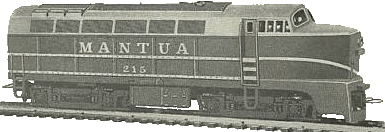
For Mantua locos, people keep saying "use LaBelle 108" when it comes to oil.
-Steve
"A lot of modellers out there who go to these train shows see broken HO stuff and go, 'This is useless' when, in reality, they can still be used for modeling whether it's as a prop on your layout or a cool project to make something old new again."
|
|
Country: USA ~
Posts: 3533 ~
Member Since: February 17 2014 ~
Last Visit: January 11 2023
|
Alert Moderator
|
|
|
|
Posted - July 08 2015 : 2:07:09 PM
|
LaBelle 107 or 108, either is fine. I use 106 for gears.
http://tycodepot.com/
|
|
|
|
mekyll
Switcher
Status:
offline
| |
Posted - August 20 2015 : 9:23:47 PM
|
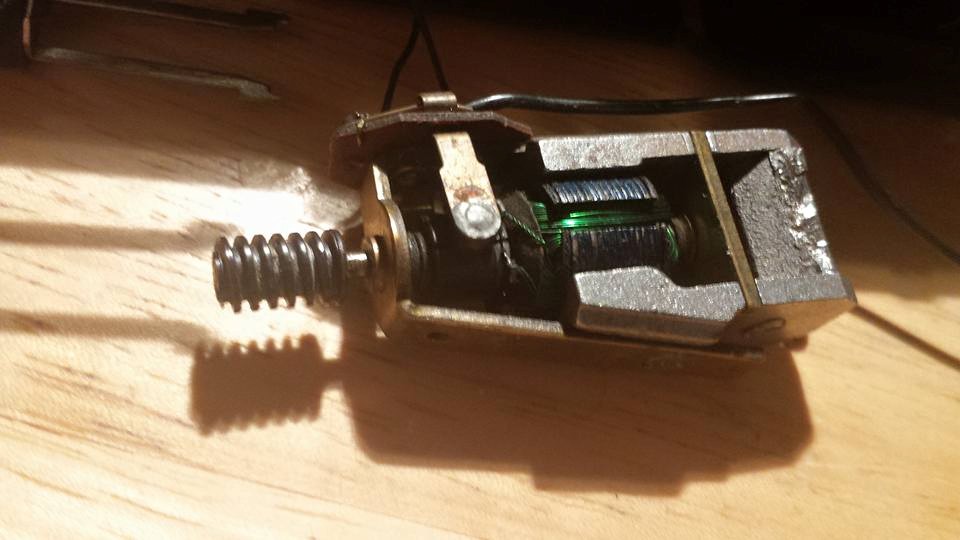
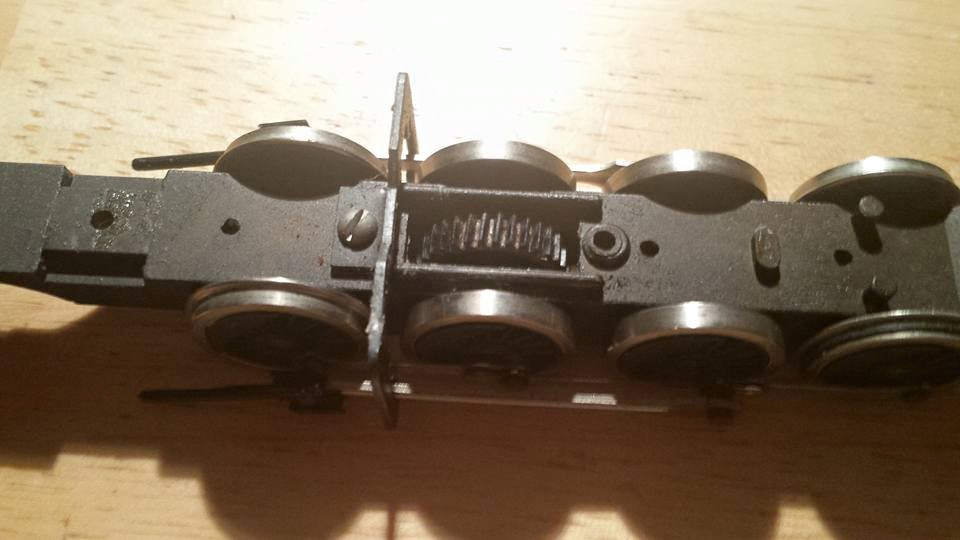
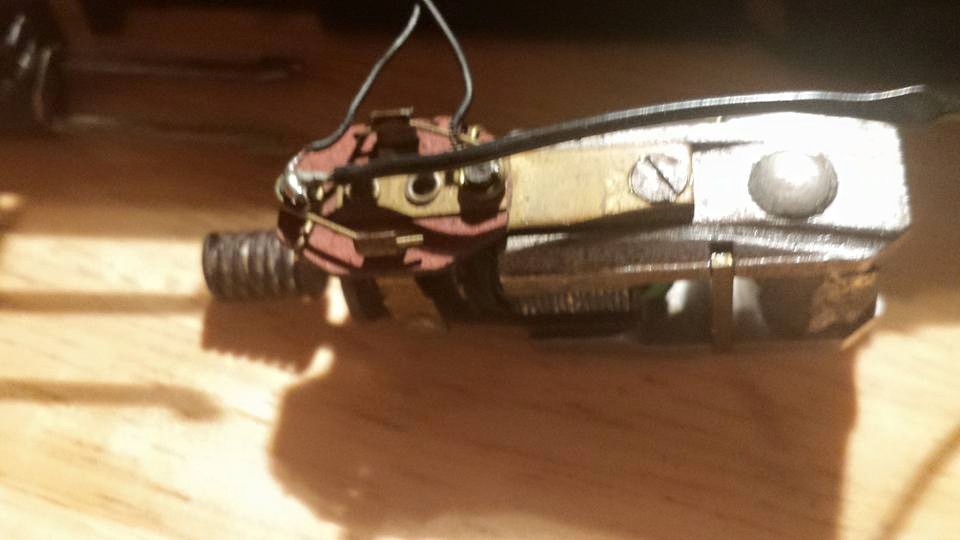
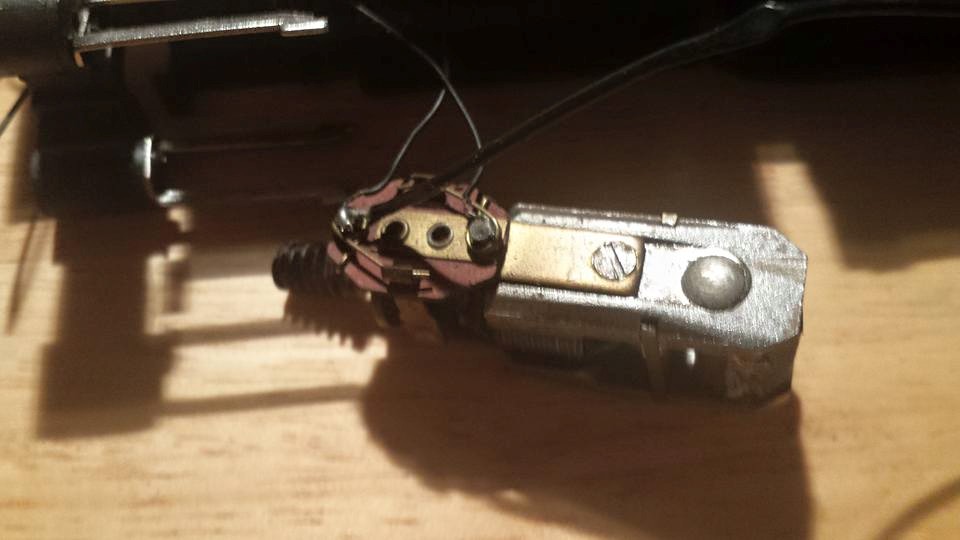
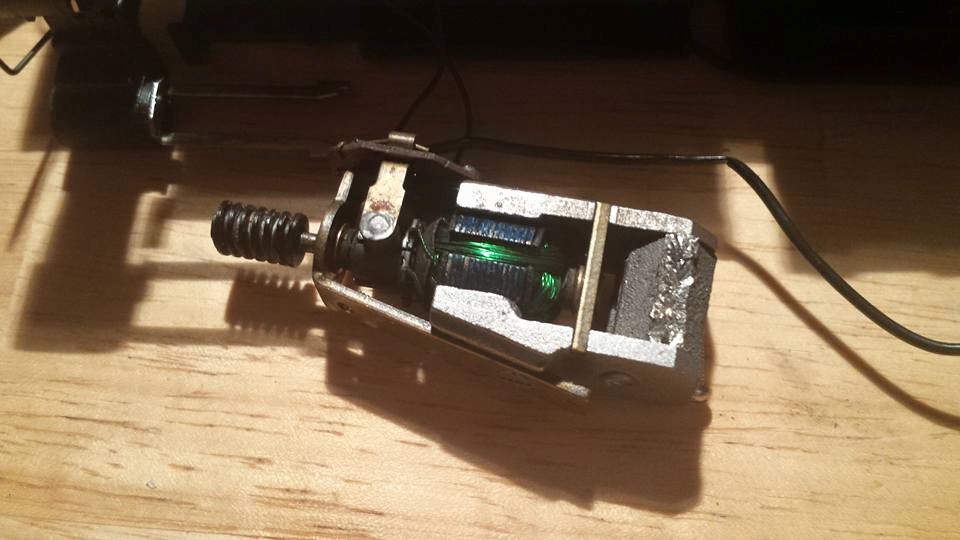
I opened her up finally, and took it apart. Motor looks good. But how can I check it without putting in back together.
I cleaned the wheels and the copper setting that the wheels sit in. Doesn't look bad for sitting for 15 + years.
What is the best course of action?
|
|
Country: USA ~
Posts: 9 ~
Member Since: July 07 2015 ~
Last Visit: July 11 2019
|
Alert Moderator
|
|
|
|
Posted - August 20 2015 : 9:42:25 PM
|
You can check the motor by putting power to it. If you have no other way, you can put power to the tracks and touch the motor frame to one rail and the wire that usually goes to the tender to the other rail.
I can't tell whether it's the light or if it's really so, but the commutator on the motor looks kind of black in the pictures. It should be shiny brass, or at least kind of shiny. If it needs cleaning and polishing, you could take off one of the brushes and polish the commutator with a pencil eraser.
The motor bearings are probably dry after all this time on the shelf. A small dab of light oil on each of them works wonders. Use very little. You don't want the oil getting on the commutator and brushes.
Carpe Manana!
Edited by - scsshaggy on August 20 2015 9:43:28 PM
|
|
Country: USA ~
Posts: 2421 ~
Member Since: September 17 2013 ~
Last Visit: September 04 2026
|
Alert Moderator
|
|
|
mekyll
Switcher
Status:
offline
| |
Posted - August 25 2015 : 4:27:39 PM
|
| the color is more of a bright blue, i will try to position it for a shot
|
|
Country: USA ~
Posts: 9 ~
Member Since: July 07 2015 ~
Last Visit: July 11 2019
|
Alert Moderator
|
|
|
|
Posted - August 25 2015 : 6:02:01 PM
|
quote:the color is more of a bright blue, i will try to position it for a shot
Originally posted by mekyll - August 25 2015 : 4:27:39 PM
|
I see that the armature cores are blue. The commutator is the part between the brushes. Is that blue, too?
Carpe Manana!
|
|
Country: USA ~
Posts: 2421 ~
Member Since: September 17 2013 ~
Last Visit: September 04 2026
|
Alert Moderator
|
|
|
|
Posted - August 26 2015 : 07:39:56 AM
|
I have found that the only thing to getting the old mantua tycos running again is usually just a good cleaning of the commutator and brushes with a rag and it works just fine.
-Peter
|
|
Country: USA ~
Posts: 99 ~
Member Since: June 11 2015 ~
Last Visit: November 10 2024
|
Alert Moderator
|
|
|
mekyll
Switcher
Status:
offline
| |
Posted - August 26 2015 : 09:18:56 AM
|
| the wire under the brushes is green
|
|
Country: USA ~
Posts: 9 ~
Member Since: July 07 2015 ~
Last Visit: July 11 2019
|
Alert Moderator
|
|
|
|
Posted - August 26 2015 : 09:46:20 AM
|
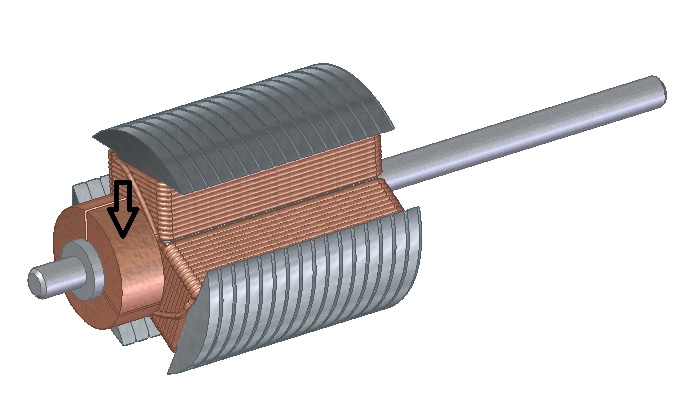
What color is this part?
Glenn
I was thinking of the immortal words of Socrates, who said, "... I drank what?"
|
|
Country: USA ~
Posts: 1713 ~
Member Since: December 13 2008 ~
Last Visit: August 07 2026
|
Alert Moderator
|
|
|
mekyll
Switcher
Status:
offline
| |
Posted - August 26 2015 : 11:09:51 AM
|
I also want to replace the light, the light was dim when it ran 20 yrs ago as it was.
Any suggestions as to what to use? The bulb comes out of the front of the headlight, and the wiring goes through the boiler (and weight) to the top of the motor (seen in the picture as the two wire lead away from the motor)
|
|
Country: USA ~
Posts: 9 ~
Member Since: July 07 2015 ~
Last Visit: July 11 2019
|
Alert Moderator
|
|
|
|
Posted - August 27 2015 : 9:39:01 PM
|
Mekyll, what we're referring to the color is the rotating assembly that the green wires go to, not the green wires, not the blue painted metal plates. That assembly is called the Commutator pads. The brushes, those two thin metal arms on either side, are the brush arms, and the brushes contact the commutator surface. That surface should look like a shiny penny. if it is black ( as it looks like in the photos ), then the brushes should be removed, and the pads cleaned carefully until the copper color comes through. Pencil erasor, green scrubbie pad, etc with some alcohol should work nicely.
As far as a bulb goes, you want a 14 to 16v bulb, Radio shack still carried 14v bulbs when they were still open in Virginia. If you have one available, they have bulbs with both smooth sides and threaded in 14v (sometimes). 12v will burn out quicker, as the power packs put out 14-16 volts. You can solder them in if necessary. Not many places carry 14-16v bulbs anymore. May have to get some online.
Jerry in VA
" When life throws you bananas...it's easy to slip up"
|
|
Country: USA ~
Posts: 3974 ~
Member Since: January 04 2009 ~
Last Visit: January 11 2019
|
Alert Moderator
|
|
 Home
Home Forums
 Events Calendar
 Forum Admins & Mods
 Register