|
|
 Posted - May 11 2015 : 4:44:27 PM Posted - May 11 2015 : 4:44:27 PM


|
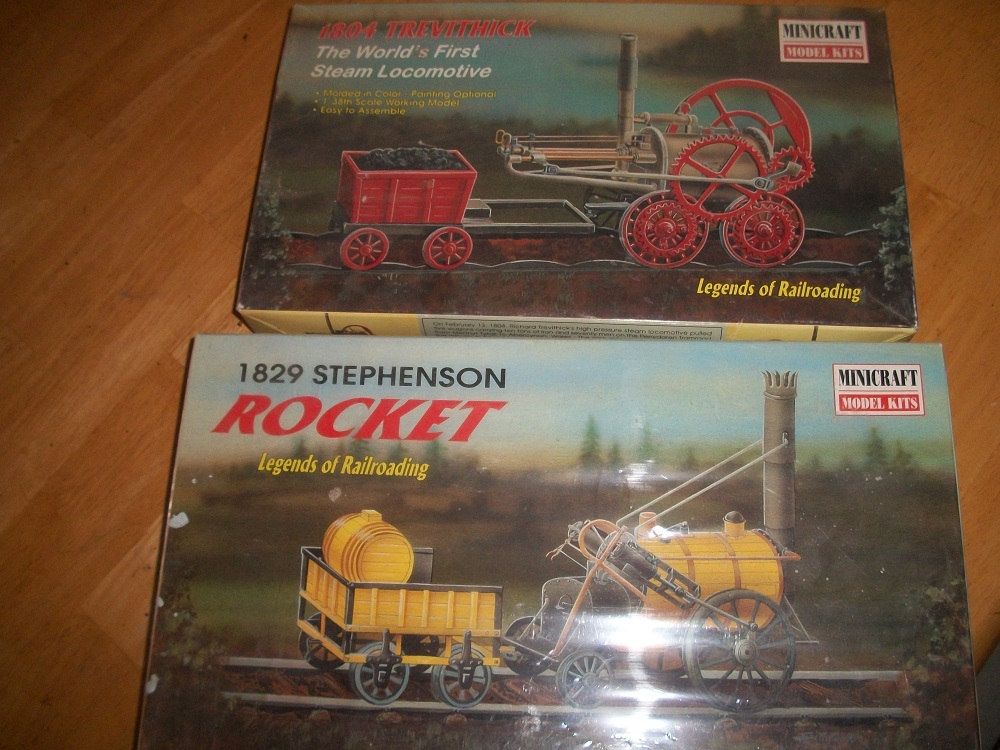
I am putting together a lecture for the local Southwest Chapter of the Locomotive
and Historical Society on early steam and thought I might build up these models
for exhibition.
I cannot find anything to tell me, either in print or internet, if either of these
locomotives used single or dual action steam introduction to the cylinder(s).
If you understand what I am referring to, you will know that dual action
was much more efficient.
I am also realizing, for the first time, that the Rocket, which could sustain 30 MPH,
does not have counter weights on its drivers. Am I correct to guess that the placement
of the piston rod close to the center of the wheel does not create enough centrifugal
action to cause a problem?
Does anyone know when driver counterweights were introduced?
Is the wooden boiler jacket on the Rocket a form of insulation?
What other facts would be of use to this lecture, on either locomotive?
I am greatly interested in your knowledge.
Edited by - Chops124 on May 11 2015 4:49:59 PM
|
Country:  USA ~
Posts: 11698 ~
Member Since: December 09 2013 ~
Last Visit: October 20 2026 USA ~
Posts: 11698 ~
Member Since: December 09 2013 ~
Last Visit: October 20 2026
|
 Alert Moderator
|
|
|
|
Posted - May 12 2015 : 09:25:31 AM
|
| Both were single action locos, it wouldn't surprise me if they needed a bit of a push to get going.
|
|
|
|
|
Posted - May 12 2015 : 10:00:11 AM
|
https://www.youtube.com/watch?v=pLJaboxC3Do
a reproduction was made of the Trevithick in 1990 
or try this one:
https://www.youtube.com/watch?v=wOGYZC-IJPQ
You might recognize the host 
Edited by - microbusss on May 12 2015 10:13:30 AM
|
|
Country: USA ~
Posts: 15047 ~
Member Since: February 23 2009 ~
Last Visit: October 20 2026
|
Alert Moderator

|
|
|
|
Posted - May 12 2015 : 11:44:47 AM
|
I may be all wet on this one, but I think counter weights on the drivers were introduced to counter balance the weight of the driving rods when they were introduced. The counter weight was forcing up when the driving rod was forcing down.
Your idea may also have merit as Shay locos do not have counter weights and small wheel diameters.
|
Country:  Canada ~
Posts: 265 ~
Member Since: March 07 2014 ~
Last Visit: June 26 2018 Canada ~
Posts: 265 ~
Member Since: March 07 2014 ~
Last Visit: June 26 2018
|
Alert Moderator
|
|
|
|
Posted - May 12 2015 : 12:25:16 PM

|
Ben,
Thanks for the British Steam History, Very interesting.
Regards, John
In youth we learn; in age we understand. <> Marie von Ebner-Eschenbach
|
|
Country: USA ~
Posts: 886 ~
Member Since: January 11 2012 ~
Last Visit: December 16 2023
|
Alert Moderator
|
|
|
|
Posted - May 12 2015 : 1:04:35 PM
|
| The Stephenson rocket was dual action. http://www.bbc.co.uk/history/interactive/animations/rocket/index_embed.shtml
|
|
Country: Canada ~
Posts: 265 ~
Member Since: March 07 2014 ~
Last Visit: June 26 2018
|
Alert Moderator
|
|
|
|
Posted - May 13 2015 : 02:31:03 AM
|
Wow, great information. This really helps a lot, many
thanks. That Rocket animation is so very helpful.
The action of the eccentric rod is amazing how it
synchronizes the D valve. Totally cool.
Now my next question is, how were those copper
flu tubes built in the 1800's? By hand, I assume,
but soldered with what? Lead? If lead, then it
would be a very precarious business keeping
the water level high enough to prevent the lead
from melting.
I have to wonder if those artisans among us, who
build complicated kits, fix trashed Con Cor basket
cases, and scratch build, experience some of the
sense of achievement people like Trevethick and
the Stephenson's felt when their creation came to
life.
|
|
Country: USA ~
Posts: 11698 ~
Member Since: December 09 2013 ~
Last Visit: October 20 2026
|
Alert Moderator
|
|
|
|
Posted - May 13 2015 : 6:35:08 PM
|
quote:If lead, then it would be a very precarious business keeping the water level high enough to prevent the lead from melting.
Originally posted by Chops124 - May 13 2015 : 02:31:03 AM
|
Water level still is life and death critical. The fire in a steam locomotive would soften steel if it were not water jacketed. If you let the water level drop below the top of the fire box, it will melt enough to pull off of the stay bolts and cave in on the fire. The boiling point of water increases with barometric pressure, so the water in the boiler is way over its flash point at atmospheric pressure. When the fire box collapses ALL the water explodes into steam at once with the force of a very large bomb.
As a precaution, there is a fusible plug, a.k.a. soft plug, in the crown sheet of the fire box. It's a hollow bronze plug filled with tin. If the steel overheats, the tin melts and the water boils over through the opening and puts out the fire. (It also blows the firebox door open and makes much excitement in the cab, but not as much as if you were being blown to buts.) In England, the low melting point metal in a soft plug is lead, so to this day, there's a part of the boiler made of lead and kept below its melting point. Incidentally, this part is higher than the flues.
I have no particular knowledge of copper flues or fireboxes, having only used locomotives with steel ones, so I don't know if the copper ones are built the same way, but a common way of installing steel flues is a press fit. You put the flue tubes in their holes and use a special tool to stretch the metal in the tube for a tight fit with the tube sheet. When the boiler heats up and expands, the seal gets even tighter. Apparently, the tube sheet expands more than the hole it occupies. I would assume you could do the same with copper.
Carpe Manana!
Edited by - scsshaggy on May 13 2015 6:45:06 PM
|
|
Country: USA ~
Posts: 2421 ~
Member Since: September 17 2013 ~
Last Visit: October 12 2026
|
Alert Moderator
|
|
|
|
Posted - May 14 2015 : 12:41:52 PM
|
Lol, I feel a sense of accomplishment every time I bring a dormant MU-2 back to life! Still haven't found one that could not be revived!quote:Wow, great information. This really helps a lot, many
thanks. That Rocket animation is so very helpful.
The action of the eccentric rod is amazing how it
synchronizes the D valve. Totally cool.
Now my next question is, how were those copper
flu tubes built in the 1800's? By hand, I assume,
but soldered with what? Lead? If lead, then it
would be a very precarious business keeping
the water level high enough to prevent the lead
from melting.
I have to wonder if those artisans among us, who
build complicated kits, fix trashed Con Cor basket
cases, and scratch build, experience some of the
sense of achievement people like Trevethick and
the Stephenson's felt when their creation came to
life.
Originally posted by Chops124 - May 13 2015 : 02:31:03 AM
|
|
|
Country: USA ~
Posts: 867 ~
Member Since: December 21 2013 ~
Last Visit: December 08 2016
|
Alert Moderator
|
|
|
|
Posted - May 14 2015 : 7:02:08 PM
|
The host is Chris Barrie aka Rimmer on Red Dwarf by BBC
|
|
Country: USA ~
Posts: 15047 ~
Member Since: February 23 2009 ~
Last Visit: October 20 2026
|
Alert Moderator
|
|
 Home
Home Forums
 Events Calendar
 Forum Admins & Mods
 Register