|
|
 Posted - February 14 2015 : 12:33:42 AM Posted - February 14 2015 : 12:33:42 AM


|
Citizens of Tyco Town:
How many times have we read something like this?
"Before John Armstrong, Linn Westcott, Frank Ellison, and others, model railroads were a bowl of spaghetti on which trains ran with little rhyme or reason."
It's on Wikipedia right now I think, or something like it, in the John Armstrong article, and I'm here to say..
Nope!
I've been reading the earliest MR's, from the 1934 12-pagers up to the mid-30s, in the MR all-time archive, and the reading simply does not bear this statement out. In fact, the earliest layouts are most often around-the-wall types, or smaller tables with an open center. HO did use more solid tables, but generally with simpler loops and yards, not the multiple levels and alternate routes we associate with the spaghetti bowl.
And model railroaders didn't run without rhyme or reason. They did run fast. They really liked to run fast. Scale modelers wrote happily about their converted Bings that could get up to 200 scale miles per hour, and after a while I realized - of course. It made sense. This wasn't the age of now, when we are preserving the memories of railroads long past. This was the age of the Hiawatha Atlantic and the brand-new powerhouse P5A, when the train was the fastest vehicle most people had personal experience with.
But they ran with reason, and their reason was mainline running, and passenger trains. 1930s layouts were more slanted towards passenger service. Every not-yet-plywood Pacific was the New Haven. Everybody wanted to be the dispatcher, sitting at an interlocking and keeping crack limiteds at bay. Ellison's great achievement wasn't introducing operation...it was making modelers fall in love with the lowly local freight.
But the spaghetti bowl, as we know it, did not exist. It did not come into its own until after the war...but it wasn't, as I had previously thought, a postwar innovation.
It was a war baby.
The postwar availability of easy-to-build track and convenient building materials made it easy. But the designs began to really appear in quantity during the war - and prominent among their designers was Linn Westcott. It is easy to see, reading the wartime magazines one after another, why design blossomed with complexity - materials were not available, time was short, and armchair dreams were many, keeping Model Railroader popular. Something was needed to fill the pages, and that was design.
Design after imaginative design spun off the pen of Linn Westcott (and later, Bill Wight, though sadly not after 1950). Railroads that overlapped each other, deceptively simple routes bent back into pretzels of complexity. You could not build it, there was no track, but you could dream it and plan it.
It was the perfect timing. After the war came many innovative forms of prefab or easy-to-build track, eventually all-but-standardizing on Atlas' snap-track design. Houses were small, but plywood was everywhere. These spaghetti bowl plans let you fit a room-sized serving of railroading on a small plywood plate. It was the right form for the postwar era, but it came from the forward-looking imagination of Linn Westcott.
Edited by - Autobus Prime on February 14 2015 12:34:59 AM
|
Country:  USA ~
Posts: 432 ~
Member Since: March 04 2008 ~
Last Visit: December 28 2018 USA ~
Posts: 432 ~
Member Since: March 04 2008 ~
Last Visit: December 28 2018
|
 Alert Moderator
|
|
|
|
Posted - February 14 2015 : 08:24:57 AM
|
There is a kind of fad that emphasizes a train passing through a scene only once on its way from point A to point B, but that doesn't invalidate the bowl of spaghetti. As always in a hobby, to each his own. Does anyone not love John Allen's Gorre and Daphetid? How many bridges can span one small canyon? 
Carpe Manana!
|
|
Country: USA ~
Posts: 2421 ~
Member Since: September 17 2013 ~
Last Visit: October 21 2026
|
Alert Moderator

|
|
|
|
Posted - February 14 2015 : 12:20:58 PM
|
Interesting blog. Myself, I kind of like the spaghetti bowl
effect. With DCC it can be wild trying to run multiple
trains to imaginary destinations.
|
|
Country: USA ~
Posts: 11698 ~
Member Since: December 09 2013 ~
Last Visit: October 20 2026
|
Alert Moderator
|
|
|
|
Posted - February 15 2015 : 09:45:41 AM
|
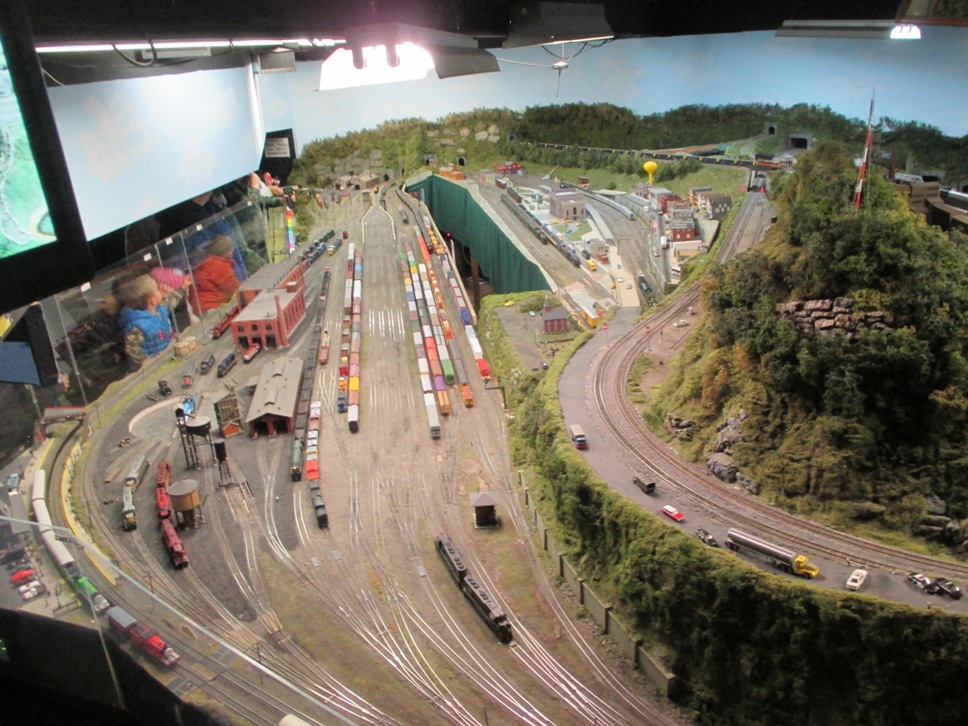
* I've also experienced this spaghetti bowl type on layouts. A friend on Broadway by Second street had one down stairs in a spare room and needed to move it to his attic. I was a part of this move. This was a overlapping layout of the spaghetti type. A home layout of restricted size. It was a never a scenic railroad, but one of overlapping layers. Most open areas only allowed for partial viewing of equipment except for the designed open area on top of the layout and on open areas planned at different locations.
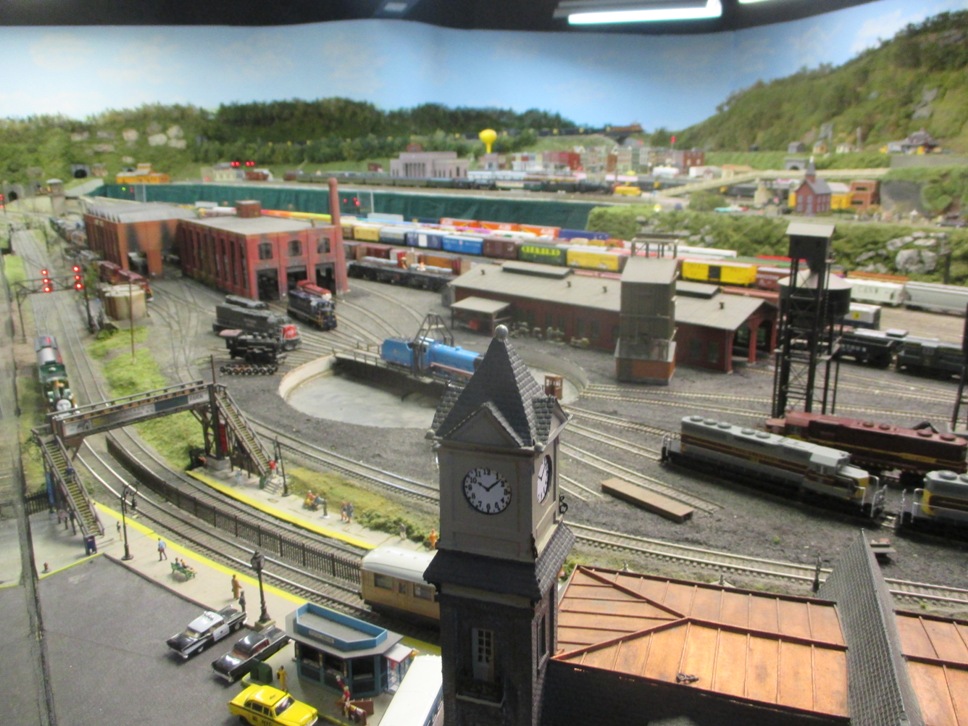
* The New York Society of Model Engineers HO layout is like that also. As almost all model railroad club layouts are. When you run a train on this type of a layout it disappears from more than half the run as it works up or down on its way to the next open area inside the structure.
* Personal preference in layout construction is a ongoing changing thing influenced by what you see, your age, ability, and most of all your finances. Starting our, hobby in this day and age with new equipment being so expensive and ones desire to have a layout to run ones trains on, this Tyco forum becomes a way to start in the hobby at a more reasonable cost. Used equipment from another time being so available in type, quantity, and price makes a good way to get started in the hobby.
frank
toptrain
" It's a Heck of a Day " !!!
|
|
Country: USA ~
Posts: 7539 ~
Member Since: August 07 2008 ~
Last Visit: June 22 2026
|
Alert Moderator
|
|
|
|
Posted - February 15 2015 : 09:59:16 AM
|
I sees Gordon on the turntable! 
|
|
Country: USA ~
Posts: 15048 ~
Member Since: February 23 2009 ~
Last Visit: October 22 2026
|
Alert Moderator
|
|
|
|
Posted - February 15 2015 : 11:16:28 AM
|
quote:I sees Gordon on the turntable!
Originally posted by microbusss - February 15 2015 : 09:59:16 AM
|
 Me too. And I also see Emily, Henry, and James in the other photos. Me too. And I also see Emily, Henry, and James in the other photos.
-Steve
"A lot of modellers out there who go to these train shows see broken HO stuff and go, 'This is useless' when, in reality, they can still be used for modeling whether it's as a prop on your layout or a cool project to make something old new again."
|
|
Country: USA ~
Posts: 3533 ~
Member Since: February 17 2014 ~
Last Visit: January 11 2023
|
Alert Moderator
|
|
|
|
Posted - February 15 2015 : 3:17:24 PM
|
I see a DMIR SD38 - that's MY cup of tea
--CRC
|
|
Country: USA ~
Posts: 930 ~
Member Since: January 25 2012 ~
Last Visit: August 23 2023
|
Alert Moderator
|
|
|
|
Posted - February 18 2015 : 12:37:45 AM
|
That NYSME layout is pretty wild, great photo. My beef with our club's layout is
that many of the access points are further than 2 feet from the aisle; and they
are loaded with turnouts. When a derailment inevitably happens, it is billy hell
to reach the victims. It would appear the NYSME has also overlooked this
consideration. Pop ups? Secret passage ways? Might be Ok if you're 20,
but much after 50 t'aint no dang phun.
Edited by - Chops124 on February 18 2015 12:38:16 AM
|
|
Country: USA ~
Posts: 11698 ~
Member Since: December 09 2013 ~
Last Visit: October 20 2026
|
Alert Moderator
|
|
 Home
Home Forums
 Events Calendar
 Forum Admins & Mods
 Register