|
|
 Posted - August 12 2012 : 11:32:41 PM Posted - August 12 2012 : 11:32:41 PM


|
Pretty sure I've seen one of these here sometime.... but can't recall for certain. Can anyone tell me who made this?
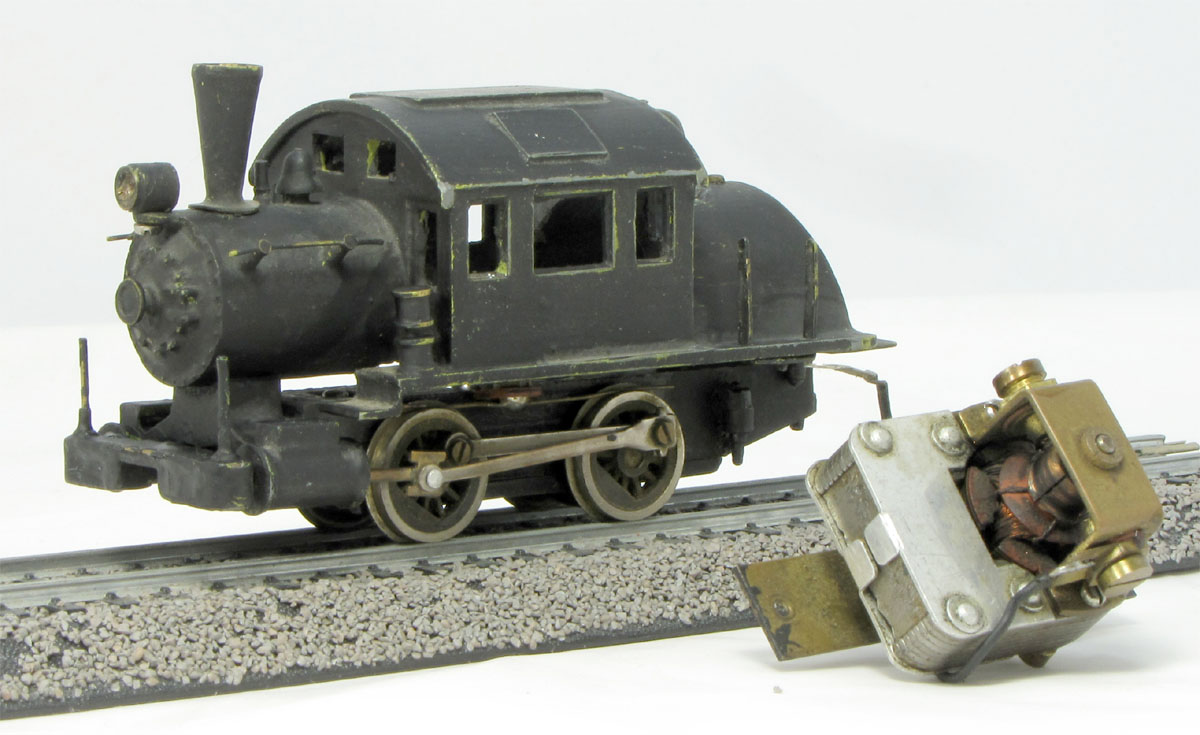
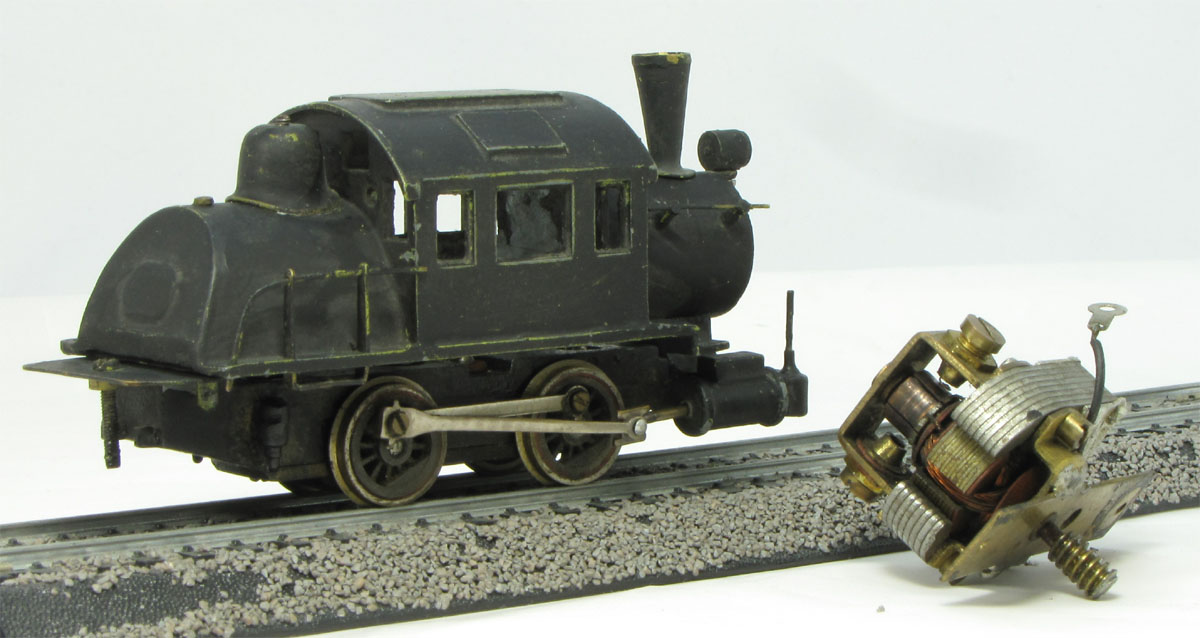
It's a diecast shell and frame with brass detail parts (stack, dome, bell, whistsle, compressor, rails). Love the way it looks. I removed the motor for cleaning, and it's rather unusual.
It runs but the brushes are worn out... so small they pop out of the shaft and get wedged in the gap atthe commutator. Does anyone have any spare brushes for that motor? I've checked my parts stash and I don't have the right size. They seem to be about 2mm or 5/64" diameter.
Any recommendations for a tender (hoping the maker ID would provide this....)?
Edited by - spiderj76 on August 12 2012 11:35:18 PM
|
Country:  USA ~
Posts: 2798 ~
Member Since: September 17 2010 ~
Last Visit: July 22 2015 USA ~
Posts: 2798 ~
Member Since: September 17 2010 ~
Last Visit: July 22 2015
|
 Alert Moderator
|
|
|
|
 Posted - August 13 2012 : 03:12:58 AM Posted - August 13 2012 : 03:12:58 AM
|
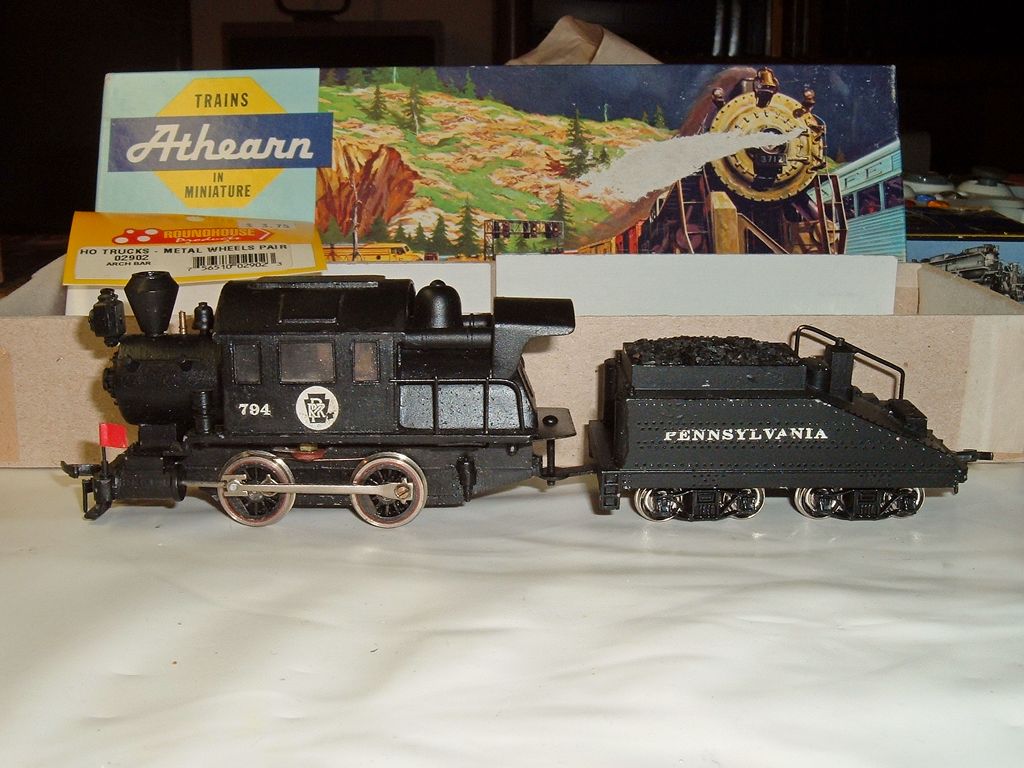
It's a New One ? Aristo-Craft Camelback 0-4-0. I recently purchased one myself that I restored.
The motor vibrated so badly that I had to balance it by drilling out two armature poles, with some success.
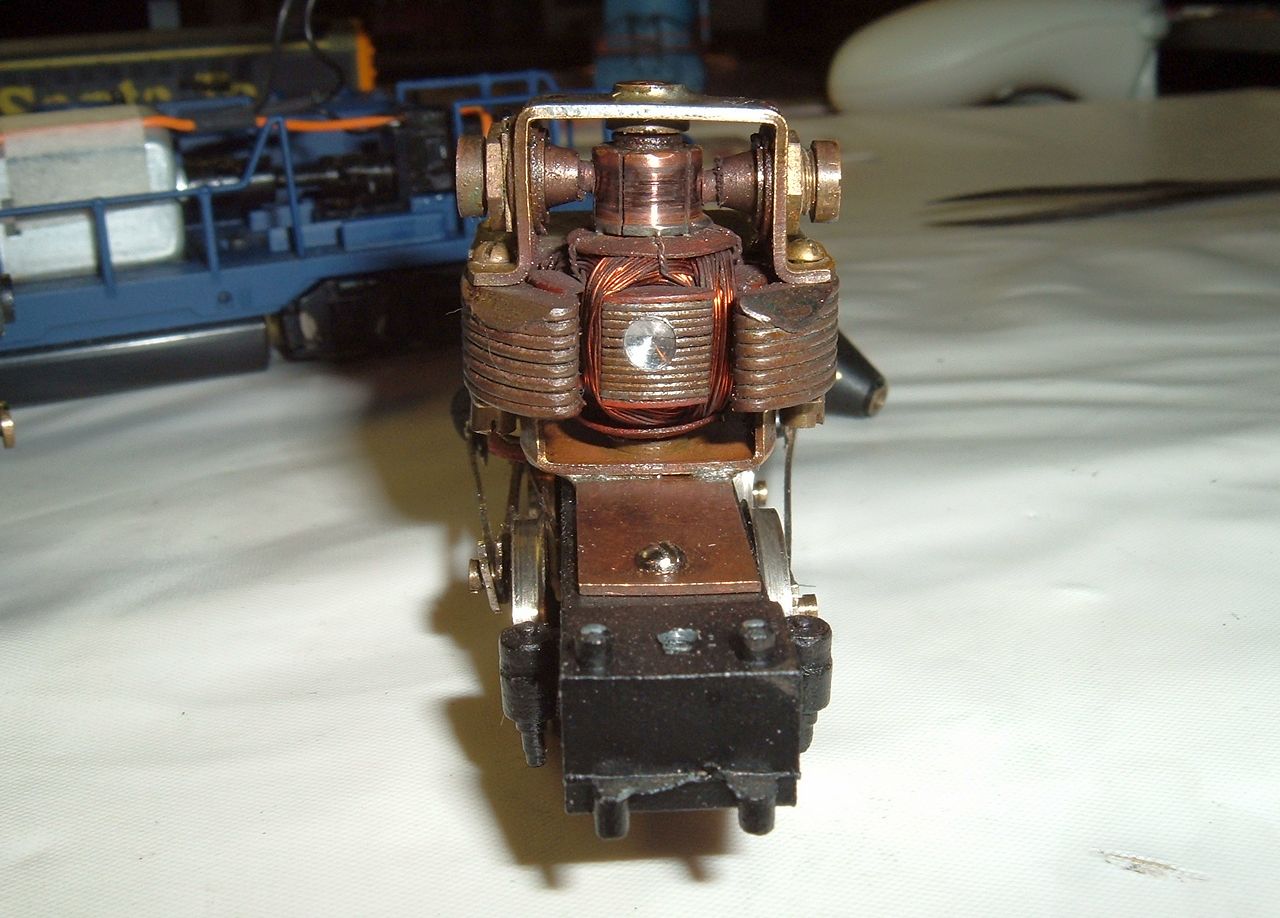
It was still noisy and the bearings are worn, so I ended up replacing it with their later diecast vertical motor, since I had a spare lying around.
As for the brushes, they're gawdawful. They're some kind of malleable coppery material, and they trail burrs behind them in the predominant direction of rotation -- I've never seen that before. Mine were nearly gone as well, plus the brush springs (and I have no idea if they were original) were incredibly stiff, exerting far too much pressure (you can see that the brush on the right is starting to bend a bit as it reaches its end). I found that cut-down brush springs from Mehano can-type motors make a good substitute. For the brushes, order some Rivarossi replacements from K4 Pacific. They are repros and a little narrower dia. than original Rivarossis, and fit my motor just fine.
The Tyco Depot
|
|
Country: USA ~
Posts: 3927 ~
Member Since: June 20 2007 ~
Last Visit: November 19 2015
|
Alert Moderator

|
|
|
|
Posted - August 13 2012 : 10:37:26 AM
|
Yeah, that's exactly what I noticed on the brushes before they wore out. The motor itself was really smooth when it ran, though, so it looks like I won't have to be as creative as you were ;)
I forgot about the control stand roof - there's a screw extending on the boiler on mine and I couldn't figure out what it was for. Is that a cast part, or brass sheet? I should be able to make one. Need to see what kind of spare tenders I have lying around. I'm not a big steam buff but I might have a Tyco slopeback somewhere.
I notice the stack and headlight are different on yours too. I wonder if they released different versions or if that was changed by the previous owner.
|
|
Country: USA ~
Posts: 2798 ~
Member Since: September 17 2010 ~
Last Visit: July 22 2015
|
Alert Moderator
|
|
|
|
Posted - August 13 2012 : 10:55:50 AM
|
hmm the motor almost looks like the one that's inside that brass Boxcab loco I got 
|
|
Country: USA ~
Posts: 15047 ~
Member Since: February 23 2009 ~
Last Visit: October 15 2026
|
Alert Moderator
|
|
|
|
Posted - August 13 2012 : 11:10:59 AM
|
quote:hmm the motor almost looks like the one that's inside that brass Boxcab loco I got
Originally posted by microbusss - August 13 2012 : 10:55:50 AM
|
Those vertical shaft motors are typical of most early Japanese & Korean brass imports.
Sean
"If everything seems under control, you're not going fast enough!" - Mario Andretti!
|
|
Country: USA ~
Posts: 1729 ~
Member Since: June 15 2011 ~
Last Visit: June 26 2021
|
Alert Moderator
|
|
|
|
Posted - August 13 2012 : 2:24:56 PM
|
Tony, the overhang is brass sheet, and there are two air tanks suspended between it and the cab that I believe are brass turnings. That's what the two holes in the rear cab wall are for, so they are gone too.
There were different versions of this loco, so stacks, headlamps, and tenders varied. I think yours is the more common version that came with the appropriate Reading style tender. The slope back on mine is too small for the loco, so the firemen would fall off the footplate trying to shovel.
One other difference I notice is that mine has an operating headlight. I had to replace the bulb which was was broken and shorted, and the wire just runs through a hole drilled diagonally up through the boiler and pops out behind the lamp. One wire was soldered to the insulated brush on the motor, but the other was soldered to the underside of the air pump on the left side to ground it to the frame.  I connected the new bulb wires to the motor, leaving enough length for shell removal. I connected the new bulb wires to the motor, leaving enough length for shell removal.
Your motor is in better condition, and I notice the bearings are press-fit. You can just see that mine are soldered in place, which is a big no-no. That cooks oil out of them, fills them with flux, etc. so they don't retain much oil. That's probably the reason for the excessive wear, and hopefully a lesson they learned by the time they made yours. I've seen that kind of construction in old Japanese tinplate mechanisms.
The Tyco Depot
Edited by - NickelPlate759 on August 13 2012 2:26:51 PM
|
|
Country: USA ~
Posts: 3927 ~
Member Since: June 20 2007 ~
Last Visit: November 19 2015
|
Alert Moderator
|
|
|
|
Posted - August 13 2012 : 10:25:31 PM
|
| I have one of those and the motor went bad. Drive-train was less than desirable too. I found that an Mantua shifter 0-4-0 and an little six 0-6-0 drive train will fit with little modification. You will need to enlarge the hole in the Mantua base under the stack for the larger diameter screw. I also lined the inside of the cab with electrical tape since the motor is extremely close to the metal body. I used the Mantua tender but could have used the New One tender if I wanted. The New One looked a little small to me. After all was said and done it is one of my more often used locomotives. Good pulling power for its size.
|
|
Country: USA ~
Posts: 332 ~
Member Since: August 28 2010 ~
Last Visit: April 23 2020
|
Alert Moderator
|
|
 Home
Home Forums
 Events Calendar
 Forum Admins & Mods
 Register