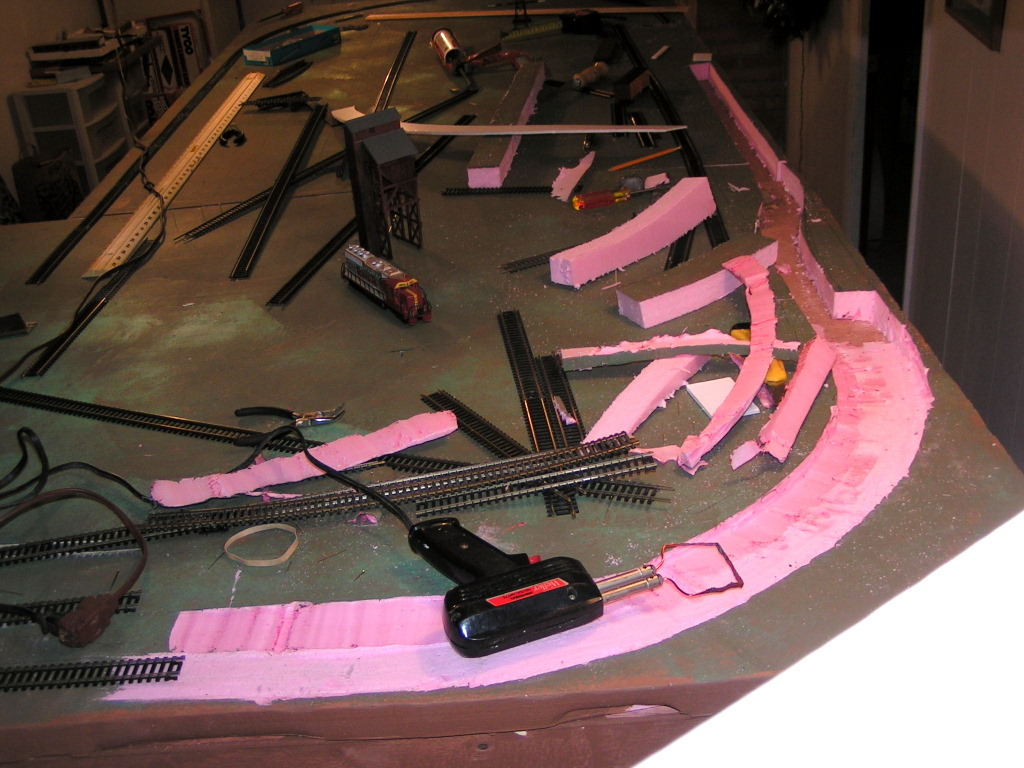
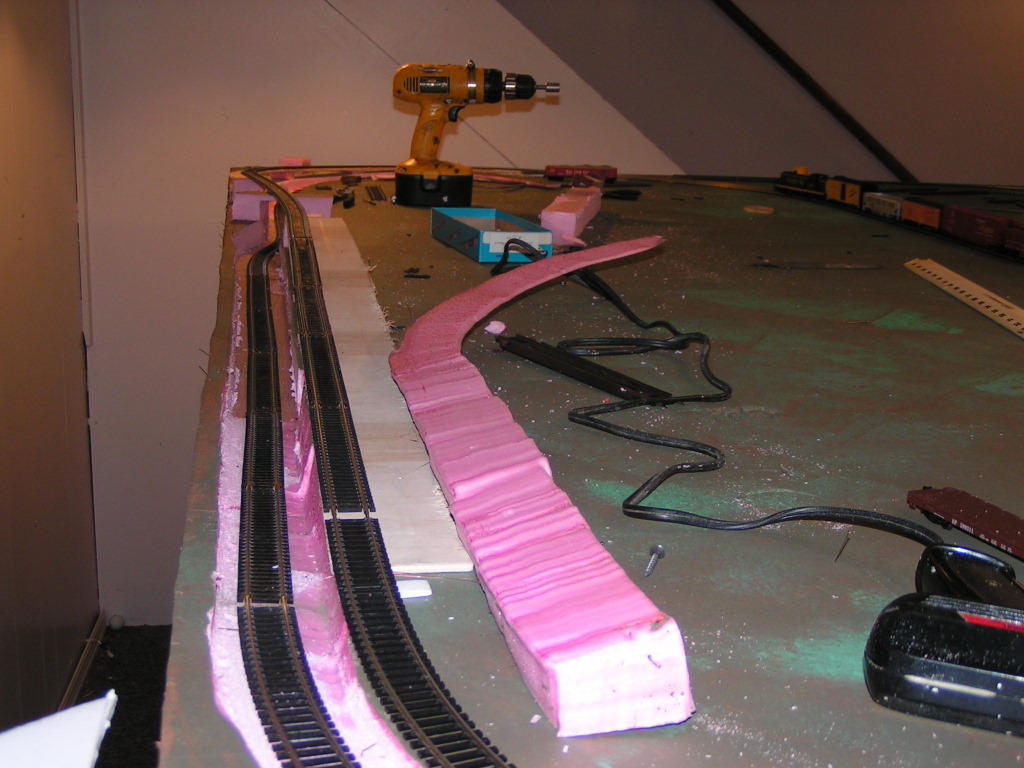
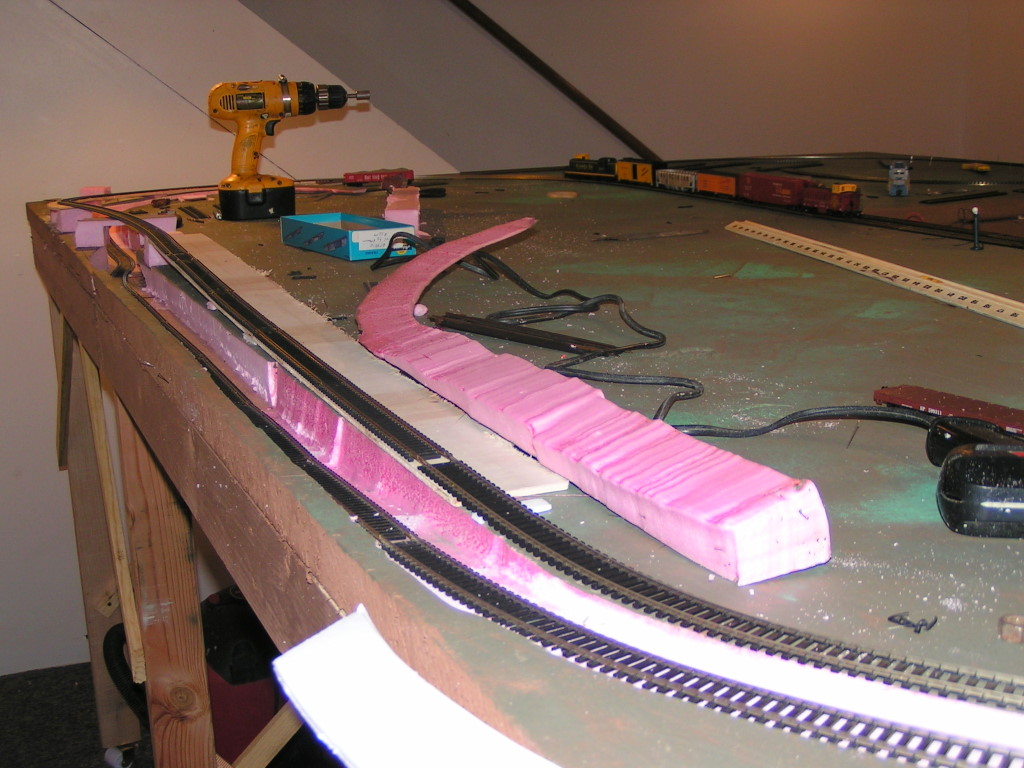
First of all I am test laying everything to see if curves and elevations work and in general i get warm fuzzies, and using 1 1/2 inch dress makers straight pins to hold down the track does the job.
If i don't like , out comes the pins and i try something else. I have pins stuck every where in the foam waiting for use
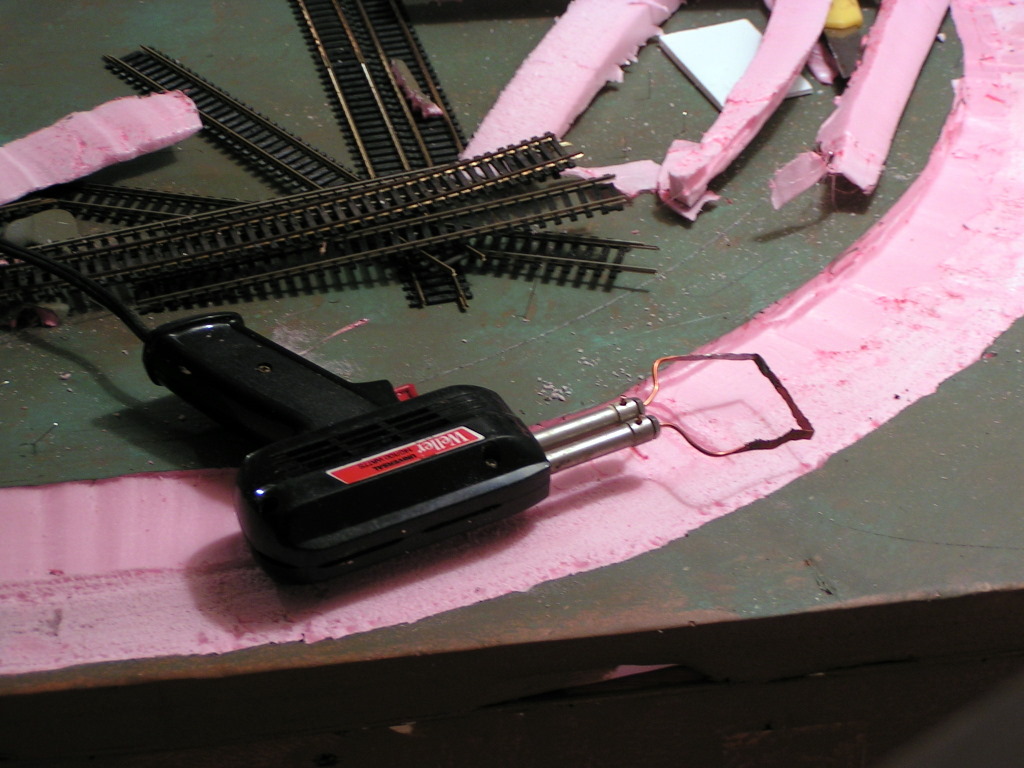
Second, I wanted a canyon so I cut out one---note my home made foam cutter. One of my long box cars scraped the canyon side, easy piece of surgery to correct
Third i didn't like part of the canyon so i cut a chunk to fill what i didn't like.
Once the canyon entrance and exit grade was roughed out a i x 2 sanding block and 80 grit sand paper fine tuned the grade.
I also wanted an over pass so a couple of pieces of foam and a strip of Luan did the job. Foam board would work as well as Luan plywood.
Once everything meets my expectations then I'll go back and glue down the road beds and make sturdier over passes. also cut and paint canyon walls before final install
Another plus I'll be able to easily cut/burn drainage ditches which really add a bit of realism. Figure I'll use the track as a guide and rig up a jig to hold a router or a hot wire.
I can shape or add to the foam to create rolling country side.
Also thinking on part of the road beds to cut a template the profile of a cork road bed and form a continuous bed using wood putty. This way i can give very slight and gradual changes in elevation
fun stuff
Country: USA ~
Posts: 424 ~
Member Since: June 25 2010 ~
Last Visit: July 30 2021
I saw a foam cutter in the HO Model Railroading 3rd edition Hand book---dated but still lots of good info. The author uses an Avalon Concepts Hot Wire Foam Sculpting Detailed Station. It comes with wire that can be bent into shapes desired and a transformer to reduce the 110 current - not cheap even by 1998 prices. I like his use of making drainage ditches using a jig that rides on the track
He also shows a Woodland Senic Hot Wire Foam Cutter with adjustable controls
being cheap and frugile I came up with my home made crude but effective cutter.
Removed the soldering tip from my Weller Solder Iron. took a piece of 12 gauge copper wire and hammered it flat, bent it into desired shape and attached to to the iron----like a hot knife through butter
Country: USA ~
Posts: 424 ~
Member Since: June 25 2010 ~
Last Visit: July 30 2021
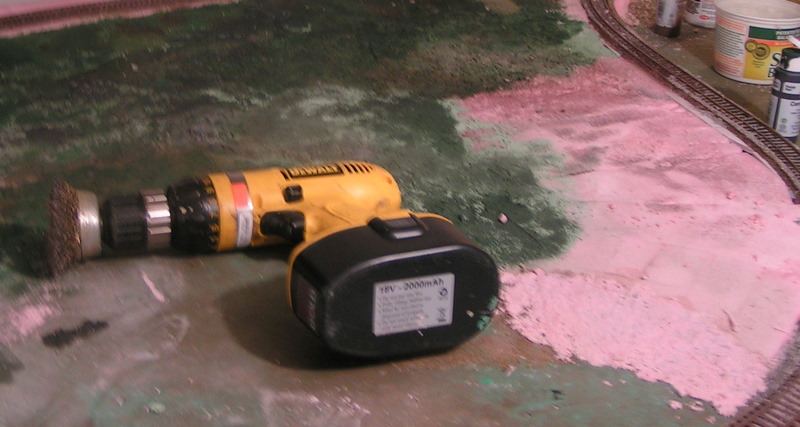
read in a book about using a wire brush to give texture..
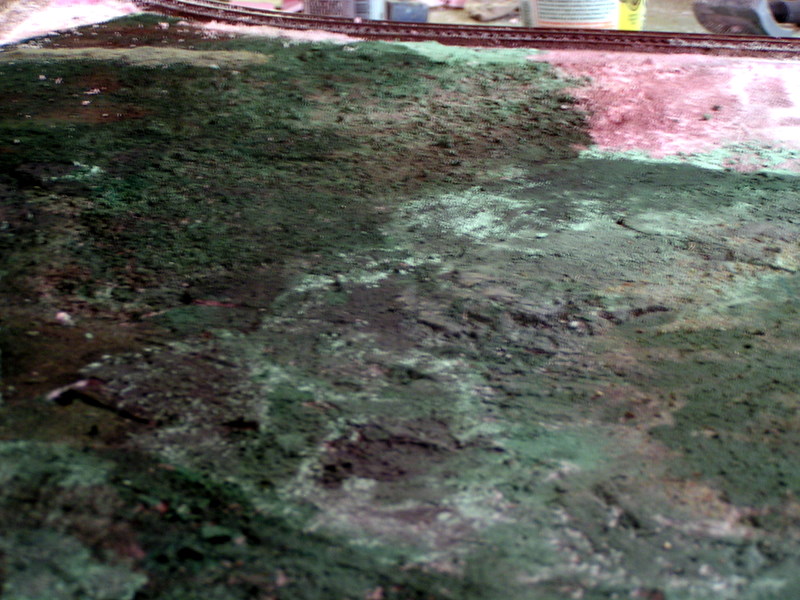
I'm making a farm with pastures and dairy cattle. I wanted to create rolling hills and avoid the pool table look.
. By using a wire brush in my drill at moderate R P M i not only made the hills but made the foam rough enough that all it required was paint to look like grass no messing around with colored ground foam. I used a stencil brush to apply the paint laying down a base color and coming back hitting the tips of the "grass" with another shade of green or brown. If i didn't like the way an area came out i'd take it down a bit with 100 grit. Other places i hit with a wire dog combing brush for row effect, a file brush would work also. Some places the drill got away from me and i left a gouge which ended up as a gray rock outcropping.
Mountains in the background with goats with water fall leading to stream is next.. Not sure if i'll work with foam or do the plaster/paper towel/strip method.
I did find that plaster of Paris drys to fast and too hard. I slowed down the drying by adding vinagar and made it easier to carve by going half and half with vermiculite
I'll be cutting a stream through the meadow for the cows to stand in
and a feed yard.
Could even raise some beef and pork and have a siding to load them for market
The pics don't give a good idea of the rolling hills
Country: USA ~
Posts: 424 ~
Member Since: June 25 2010 ~
Last Visit: July 30 2021
 Home
Home Forums
 Events Calendar
 Forum Admins & Mods
 FAQ
FAQ Register



 Posted - August 24 2010 : 6:41:05 PM


 USA ~
Posts:
USA ~
Posts: 



 Canada ~
Posts:
Canada ~
Posts:  I'm gonna have to give this a try. Thanks!