|
|
 Posted - February 03 2018 : 7:23:57 PM Posted - February 03 2018 : 7:23:57 PM


|
![]() If you've ever looked through old model railroad magazines, you will often find some real gems of plans, often designed for 4x8 tables. There are some great ideas there, but often the design itself is impractical. In this thread I will show how to modify the plan of one such railroad, the Buckley & Onarka. If you've ever looked through old model railroad magazines, you will often find some real gems of plans, often designed for 4x8 tables. There are some great ideas there, but often the design itself is impractical. In this thread I will show how to modify the plan of one such railroad, the Buckley & Onarka.
This railroad represents a small Appalachian shortline, and as a result boasts sharp curves and steep grades. Typical motive power would be small steam locomotives, or 4 axle diesels bought secondhand from larger railroads that no longer wanted them. All of these are suitable for the 18" radius curves used in the plan.
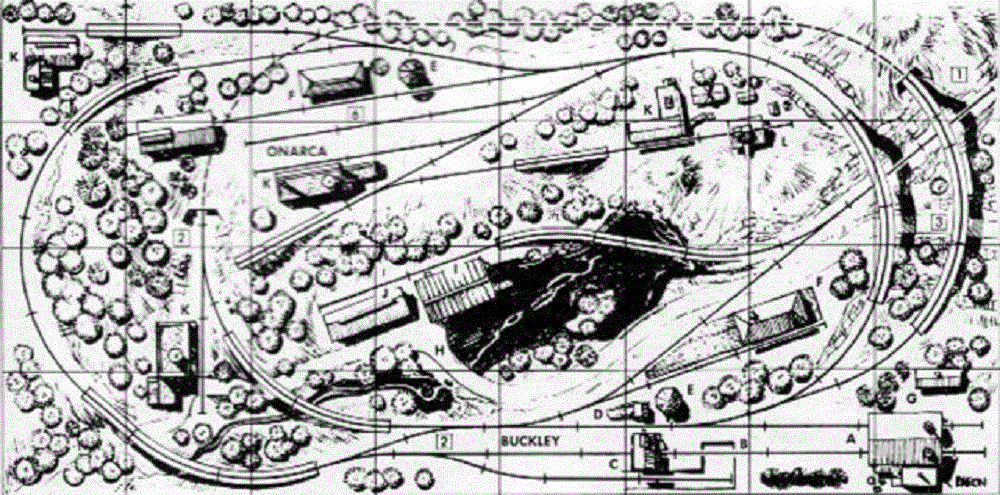
This is the original published plan. I am not sure of its original publication, but it recently appeared in the book "101 Track Plans for Model Railroaders." This is a mountain railroad, a step beyond the typical flat 4x8 many of us start with the steep grades and sharp curves keep train lengths short, well within the capabilities of your locomotives, and the construction of small towns and industries in the mountains should keep you busy for a long time, at least in theory.
But as drawn here, this plan has some serious drawbacks. For one thing, the grades are way too steep. Notice the elevations on the plan. Buckley sits at elevastion 2?, and Onarka at a whopping 6 making the grade between them something even Shays would fear to tread. Add to that the use of train set switches, which have an 18" radius curve in them, and the track arrangements in the yards that result in 18" radius s curves with very little straight track between them. You might be able to get away with this if you run short cars with truck mounted couplers, but you will run into other problems when you try to back those cars into the industry tracks. Cars with body mounted couplers perform better during backing, but HATE those s curves.
I will show you how to eliminate those problems while still keeping with the original plan.
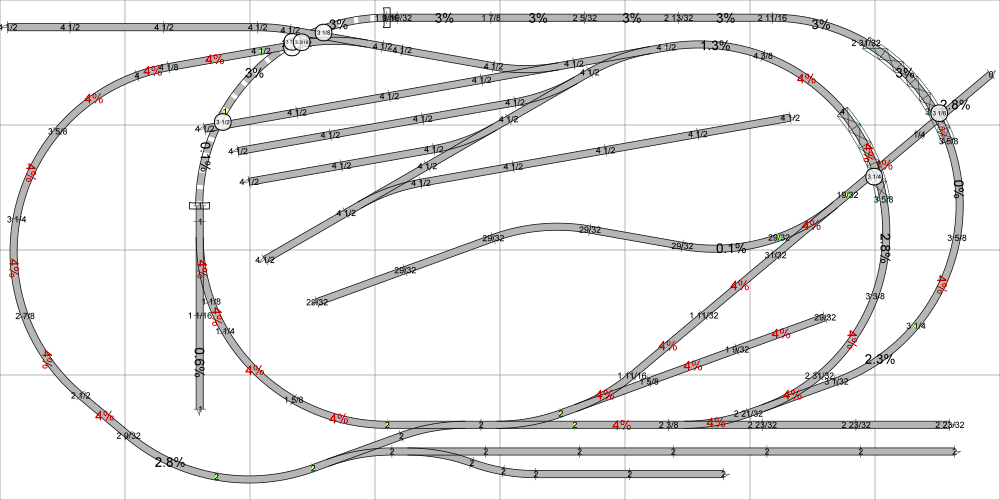
Here is the original track plan, redrawn using Anyrail, a program which allows you to plan layouts on your computer using the track sections of a variety of manufacturers. Since Atlas components can be used without modification, I opted to use Atlas track in this and all subsequent plans. It also allows you to see the grades of all track, along with heights of all track joints. I set some standards that could not be deviated from, based upon my own experience. These standards are a minimum of 3" overhead clearance where one track must bridge another, and a maximum grade of 4%.
About the only modification i made here was to lower the elevation of Onarka from 6" to 4 1/2" in order to keep the grade to 4%. This plan is the minimum modification that must be made in order to have a usable layout. The s curves are all still there, they will be eliminated later.
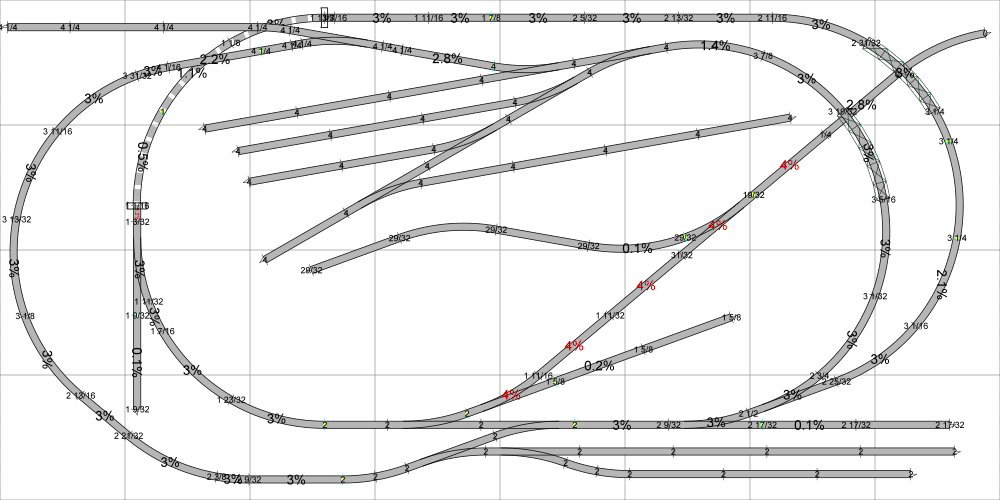
In this revision, I rearranged the switches at Buckley in order to eliminate the one of the S curves, but the others remain. This revision has the added benefit of allowing me to reduce the grades on the main tracks to 3%, though the switchback branchline is still 4%.
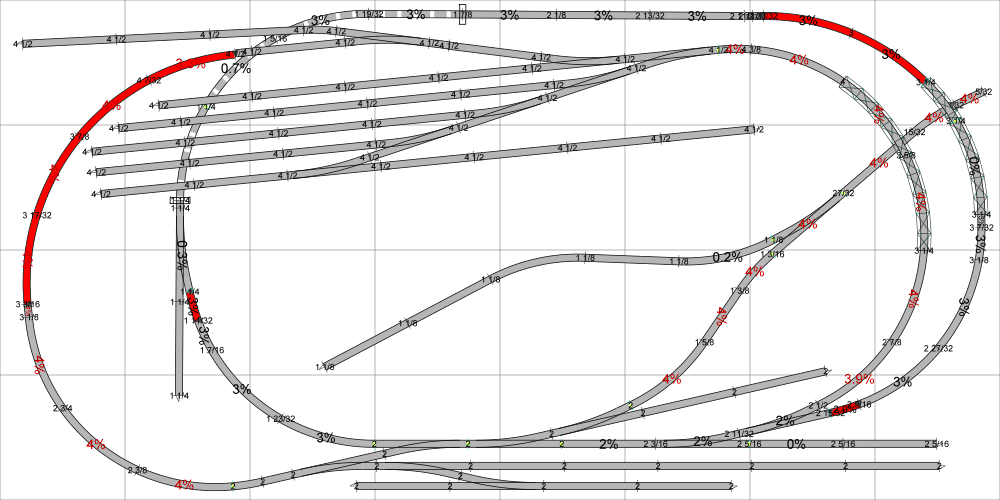
In this revision, I substituted Atlas #4 switches for the previous snap switches. Why? #4s have a much gentler curve and virtually eliminate the s curve problem. To demonstrate this, I reverted to the original track arrangement as much as possible.
The gentler curve of the #4s allowed me to add an extra yard track at Onarka, but brought the grades on the mainline back to 4%. They also necessitated modification of the branchline by adding some curves that will enhance its visual effect. The curved side of a snap switch is 20 degrees, whereas the curves side of a @4 is 12 1/2 degrees. necessitating this change in order to maintain clearance where the branch passes under the mainlines. Another modification was the use of 22" radius curves in certain places, marked in red on the plan.
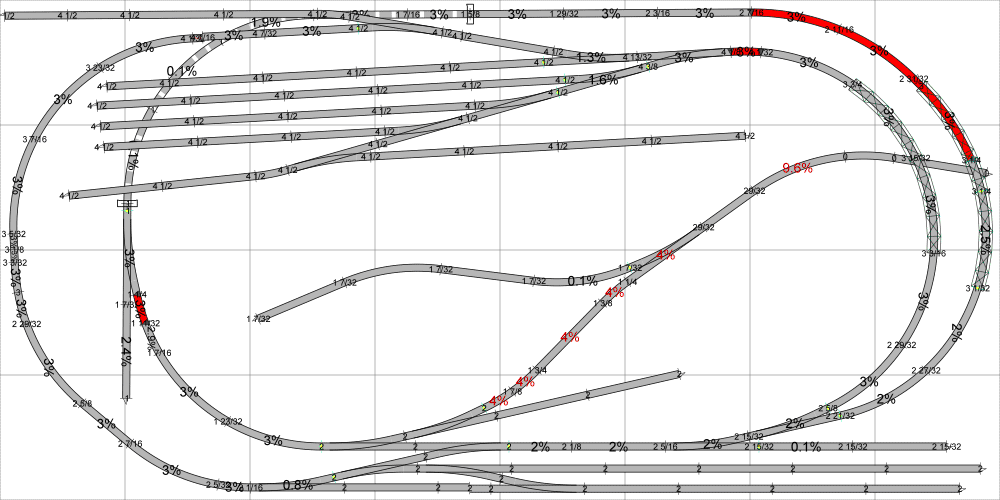
Finally, I rearranged the switches at Buckley once again, and reduced the mainline grades to 3% once more. Note the addition of a short runaround track. As before, several sections of 22r were used, and marked in red.
Edited by - jward on February 03 2018 8:25:51 PM
|
Country:  USA ~
Posts: 634 ~
Member Since: December 22 2013 ~
Last Visit: October 18 2026 USA ~
Posts: 634 ~
Member Since: December 22 2013 ~
Last Visit: October 18 2026
|
 Alert Moderator
|
|
|
|
Posted - February 03 2018 : 7:25:35 PM
|
| no pix
|
|
Country: USA ~
Posts: 15047 ~
Member Since: February 23 2009 ~
Last Visit: October 15 2026
|
Alert Moderator

|
|
|
|
Posted - February 03 2018 : 7:39:45 PM
|
not sure why the images aren't showing. I am working on trying to figure it out.
|
|
Country: USA ~
Posts: 634 ~
Member Since: December 22 2013 ~
Last Visit: October 18 2026
|
Alert Moderator
|
|
|
|
Posted - February 03 2018 : 8:53:47 PM
|
ok it woiks nao
|
|
Country: USA ~
Posts: 15047 ~
Member Since: February 23 2009 ~
Last Visit: October 15 2026
|
Alert Moderator
|
|
|
|
Posted - February 03 2018 : 9:55:15 PM
|
jward,
Many thanks for taking time out to describe the pros and cons of grades, elevation, switches, etc..., along with using the anyrail software to provide alternatives. Other than a simple oval, I have yet to build my 1st set since high school, but I will definitely remember this article.
|
|
Country: USA ~
Posts: 553 ~
Member Since: February 18 2013 ~
Last Visit: January 01 2026
|
Alert Moderator
|
|
|
|
Posted - February 04 2018 : 2:47:04 PM
|
Like many of us, I've gazed at many track plans. You really picked
a beauty, I must say, and I've never before seen it.
One Atlas track plan I tried to replicate featured an elevated
switching area accessing a coal mine. It was quickly discovered
that a turnout placed at the base of a grade is an invitation
for derailment. This would be attributed to the weight of the
train shoving against frogs down hill, and the slight warping
of rails uphill.
|
|
Country: USA ~
Posts: 11693 ~
Member Since: December 09 2013 ~
Last Visit: October 13 2026
|
Alert Moderator
|
|
|
|
Posted - February 04 2018 : 7:11:42 PM
|
I have to wonder if there was some sort of notational drift, if in the original publication of the plan those elevation numbers were just reference numbers for the elevations, instead of being used as inch measurements of them.
Feedback-hungry attention w****
|
|
Country: USA ~
Posts: 750 ~
Member Since: December 05 2015 ~
Last Visit: January 24 2024
|
Alert Moderator
|
|
|
|
Posted - February 04 2018 : 8:09:50 PM
|
@ chops.
While it is not a good idea to have sudden changes in grade coming into switches, I have to wonder if there was something else going on with your layout. I don't have the types of problems on my layout that you describe, even though one of my switches is right at the bottom of a 4% grade, The worst problems i have had in that spot are due to kadee trip pins being too low,
I suspect from your description of train weight skewing the trucks that you were using older cars with truck mounted couplers. When the slack is bunched in a train, such as with backing or in your case running a heavy train downhill, the couplers tend to push to the side. If all your cars have body mounted couplers, this sideward force is transferred to the car itself, and the trucks tend to stay aligned with the rails. But with truck mounted couplers, that force pivots the trucks so that they are skewed to the rails. And that is asking for derailment problems.
Add to that the fact that many switches, especially older ones, do not meet NMRA specs with regards to the flamgeways in the guardrails and frog. Properly spaced, the guardrails should guide the wheel flanges away from the point of the frog. Of they're too wide, as many are, they do not provide that protection. In your case the problem would be worsened because the trucks would be skewed, and the flanges would be looking for any flaw in the trackwork to derail.
Fortunately, there is a relatively simple fix to the flangeway problem. You can fill in the flangeways a little by glueing styrene strips to the plastic guard rails to narrow the gap, then trimming the tops of the styrene level with the top of the guard rail with an Xacto knife. Checque the flangeway width against an NMRA guage, and if it is too narrow a hacksaw blade is the perfect width to clear it out.
As for the truck mounted couplers, i try not to run cars like that. It may take a little work, but in most cases you can convert them to body mounted couplers (Kadee preferred.)
Fortunately, the model manufacturers in recent years have paid much closer attention to NMRA standards, and most cars come with Kadee compatable couplers that are already body mounted at the correct height,
As for the plan itself, the one i used here can be further improved by using a 5x9 table and 22" radius curves.
|
|
Country: USA ~
Posts: 634 ~
Member Since: December 22 2013 ~
Last Visit: October 18 2026
|
Alert Moderator
|
|
|
|
Posted - February 05 2018 : 09:42:52 AM
|
I'm sure it can, and I'm sure that's nice for the people who have the space for such, but not everyone does.
Feedback-hungry attention w****
|
|
Country: USA ~
Posts: 750 ~
Member Since: December 05 2015 ~
Last Visit: January 24 2024
|
Alert Moderator
|
|
|
|
Posted - February 20 2018 : 01:13:49 AM
|
Thanks JWard, and your revised plan is nothing short of superb.
It's the kind of plan I'd love to take a crack at, what with the
opportunity to pick up, deliver, classify, and run. This fine
track plan begs DCC for multiple train operation.
The problems I encountered were a combination of
tremendous enthusiasm and limited experience. Your
work here would probably exceed expectation, and thank you
for the flangeway tips.
|
|
Country: USA ~
Posts: 11693 ~
Member Since: December 09 2013 ~
Last Visit: October 13 2026
|
Alert Moderator
|
|
 Home
Home Forums
 Events Calendar
 Forum Admins & Mods
 Register